

Compare oat milk vs almond milk: Which Non-Dairy Milk Reigns?

Oat Drink vs Almond Drink: The Quick Verdict
Two non-dairy drinks dominate the shelf. Oat drink and almond drink. They look similar in the carton. They behave very differently in your cup.
Here is the short answer.
Choose oat drink if you want a creamier texture, more fibre, and a neutral taste that works in coffee. Choose almond drink if you want fewer calories, fewer carbs, and a lighter, nuttier flavour.
That is the headline. The details matter more, so let us compare them properly.
Key Takeaways
- Oat drink has more carbs, fibre, and protein per serving than almond drink.
- Almond drink is lower in calories and carbs.
- Oat drink tends to foam and steam better in coffee.
- Almond drink uses far more water to grow than oats.
- Both formats share one hidden problem: liquid cartons spoil fast and ship heavy.
- Powder oat drink solves that problem. You mix only what you need.
Side-by-Side Comparison Table
| Category | Oat Drink | Almond Drink |
|---|---|---|
| Base ingredient | Oats | Almonds + water |
| Calories per cup | Higher | Lower |
| Carbohydrates | Higher | Lower |
| Protein | Higher | Very low |
| Fibre | Source of fibre | Very low |
| Taste | Neutral, mildly sweet | Nutty, light |
| Coffee performance | Foams and steams well | Can separate, thin foam |
| Water to grow | Lower | Much higher |
| Common additives | Oils, gums in many cartons | Gums, stabilisers in many cartons |
| Allergen note | Gluten unless certified | Tree nut |
We will explain each row below.
Taste and Texture
This is where most people decide.
Almond drink tastes light and nutty. It works well in cereal and cold drinks. In coffee, the thin body can feel watery. The nutty note can also clash with darker roasts.
Oat drink tastes neutral and mildly sweet. It carries a creamier mouthfeel. This makes it the popular choice in cafes. If you want to understand the flavour profile in detail, we cover what oat drink tastes like in a separate guide.
One barista history channel summed up why cafes shifted toward oats.
"Baristas discovered something crucial. Oat milk behaved more like dairy. It steamed better, foamed consistently, and didn't overpower coffee's flavor. Once cafe culture adopted oat milk, the rest followed quickly." — History of Simple Things, _YouTube Channel dedicated to historical explanations of everyday items_
Texture is personal. Many coffee drinkers prefer the body of oats. Many cold-drink fans prefer the lightness of almond.
Nutrition Breakdown
Nutrition is the most common reason people compare these two. The honest answer is that they serve different goals.
Almond drink is lighter. Oat drink is more filling.
"Unsweetened almond milk offers a low-calorie, low-carb alternative to dairy, which could be most beneficial for individuals with diabetes or trying to lose weight. On the other hand, oat milk is higher in carbs since it comes from oats. This is a good alternative for individuals with intolerances to dairy or those trying to avoid dairy overall." — Candice Pumper, _Staff Dietitian at The Ohio State Wexner Medical Center's Comprehensive Weight Management and Bariatric Surgery Program_
A registered dietitian put the calorie gap in simple numbers.
"They showed obviously that almond has at least [calories] 25, oats a little more, 100, and soy is a little less, 80." — Dr. Mark Hyman, _Director of the Cleveland Clinic for Functional Medicine_
So almond drink wins on calories and carbs. Oat drink wins on fibre and protein.
"Oat milk is higher in calories, carbs, and protein than almond milk. It's also a good source of fiber, which is important for digestive health." — Rachael Ajmera, _MS, RD_
"Almond milk is naturally low in calories and carbs, and it's a good source of vitamin E. However, it's also very low in protein and other important vitamins and minerals." — Rachael Ajmera, _MS, RD_
The fibre point matters for many people. Oats are a whole grain. That is why oat drink carries soluble fibre that almond drink does not.
"Several types of oat milk contain up to 2 grams of fiber and 3 grams of protein per cup." — Nichole Dandrea-Russert, _M.S., R.D.N., Registered Dietitian Nutritionist at Purely Planted_
For nut-allergy households, the choice is clear.
"Both oat milk and almond milk are great options for people who can't do dairy. Oat milk has the added benefit of being both nut-free and dairy-free, which is a plus for those who may have nut allergies. And oat milk has a higher fat and proteian content than almond milk, which helps with satiety." — Carolyn Williams, _Ph.D., RD_
The simple summary comes from another dietitian.
"If you're looking for a low carb option, almond milk is a better choice. If you're looking for a milk alternative that's higher in protein and fiber, oat milk is a better option." — Rachael Ajmera, _MS, RD_
Oats are a natural source of beta-glucan, a soluble fibre. We have not lab-tested the specific beta-glucan content per serving of any single product here. We cover the oat science in our evidence-backed look at oats if you want the research.
Price Per Serving
Both drinks sit in a similar price band in most EU supermarkets. Premium versions of either can climb past 3 € per liter. Store brands cost less. Prices vary by country and brand, so check your local shelf.
The bigger cost question is waste. We return to that below.
Sustainability
This is one category with a clear gap. Almonds need a lot of water to grow.
"Oats are much easier to grow and require less water than almonds, making oat milk a sustainable choice for eco-conscious individuals." — Health Journey, _Health and Wellness Educator (from channel description)_
A senior clinical dietitian framed the land-and-water difference plainly.
"From a water-use and land-use perspective, oat milk is a better choice, since it takes far less land and water to produce a gallon of oat milk compared to a gallon of almond milk." — Dana Ellis Hunnes, _PhD, MPH, RD, senior clinical dietitian UCLA Medical Center_
So oats win on water and land. That is a genuine environmental advantage for oat drink over almond drink.
There is a second sustainability factor that almost no comparison mentions. Packaging and transport. A liquid carton is mostly water. You ship that water across Europe in heavy cartons. Powder ships dry. More on that in the next section.
The Hidden Problem Both Liquid Formats Share
Here is the variable most oat-vs-almond articles miss.
Both drinks usually come as liquid cartons. That format creates three recurring problems.
Problem one: many cartons contain added oils and stabilisers. People who switch to plant drinks for cleaner ingredients are often surprised by the label.Problem two: cartons spoil fast once opened. A single person rarely finishes a carton in time."Why does it say oat milk on the front but then I read the label and there is rapeseed oil and sunflower lecithin in there. I thought I was buying oats." — _verified customer review_
"Opened it after 3 weeks in the fridge and it smelled off. Had to throw out half a carton. At these prices that really stings." — _verified customer review_
You can read more about how long oat drink lasts once opened in our shelf-life guide.
Problem three: liquid splits in hot coffee. This affects both formats."I pour it into my coffee and it curdles immediately. Every single time. Switched brands three times and same result. Is hot coffee just not compatible with oat milk?" — _verified customer review_
These are not problems with oats or almonds. They are problems with the liquid carton format. There is a third option that sidesteps all three.
Oat Drink Powder: The Format Most People Have Not Tried
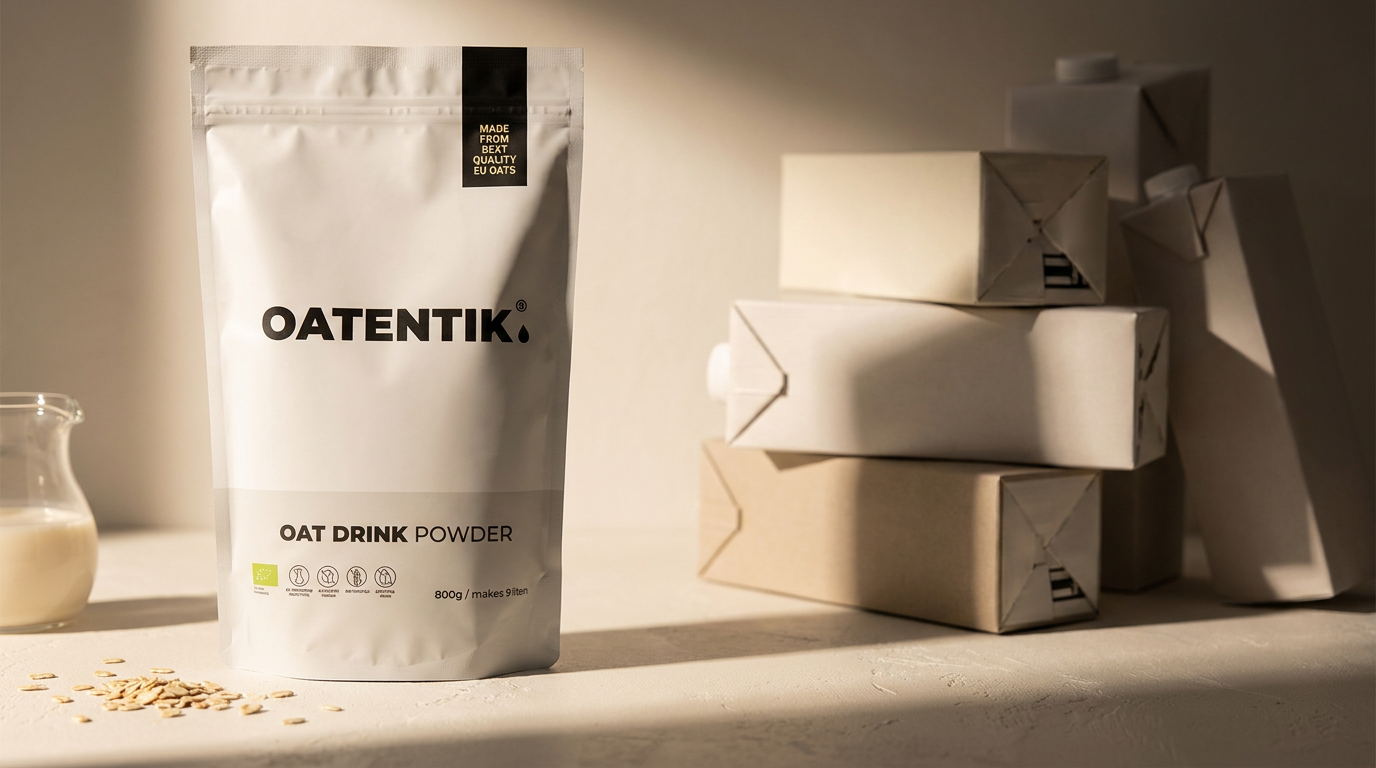
Oat drink also exists as a powder. You mix it with water in seconds. You make only what you need.
This solves the carton problems directly.
- No half-cartons spoiling, because you mix one cup at a time.
- A clean label is possible, because powder does not need oils to hold a liquid emulsion.
- A stable cup, because a good powder is formulated for hot drinks.
One customer described the moment it clicked.
"Finally found a way to drink my coffee without dairy and without all the additives. Made my first cup with oat drink powder this morning. Mixed in 20 seconds, frothed beautifully, no weird taste. This is actually what I was looking for all along." — _verified customer review_
OATENTIK is made from two things. Organic gluten-free oats and a natural enzyme. The enzyme breaks oat starch into natural sweetness and creaminess. There are no oils, no gums, no fillers, and no added sugar. You can read how the two-ingredient process works if you want the science.
One pouch (800g) makes 8 liters of oat drink. It stores at room temperature for up to 24 months unopened. And it uses 93% less packaging than the cartons it replaces
. 17 grams of pouch replaces around 240 grams of carton material for the same 8 liters. That is a bonus, not the main point.
Who Should Choose Which
Choose almond drink if you:- Want the lowest calories and carbs.
- Like a light, nutty flavour.
- Do not have a nut allergy.
- Mostly use it cold, in cereal or smoothies.
- Want a creamier texture for coffee.
- Want more fibre and protein.
- Have a nut allergy.
- Do not mind finishing a carton within a few days.
- Want oat drink without the carton waste.
- Live alone or travel often.
- Want a clean label with no oils or gums.
- Want a stable cup in hot coffee.
There is no single winner for everyone. The right choice depends on your taste, your kitchen, and how fast you drink it.
Frequently Asked Questions
Is oat drink or almond drink better for coffee?
Oat drink usually performs better in coffee. It has a creamier body and foams more consistently. Almond drink is thinner and can separate in hot coffee. Powder oat drink formulated for hot drinks stays stable in the cup.
Which has fewer calories, oat drink or almond drink?
Almond drink is lower in calories. Unsweetened almond drink can be around 25 calories per cup, while oat drink is often closer to 100. The exact number depends on the brand and whether sugar is added.
Is oat drink more sustainable than almond drink?
Oats need far less water and land to grow than almonds. From a water-use and land-use view, oat drink has a smaller footprint. Powder formats reduce packaging and transport weight further, because you do not ship water.
Does oat drink contain added sugar?
Many carton oat drinks do not add sugar, but some flavoured versions do. Always read the label. With OATENTIK, the natural sweetness comes from breaking down oat starch with an enzyme. No sugar is added.
Can I drink oat or almond drink with a nut allergy?
Oat drink is nut-free, so it suits people with a tree-nut allergy. Almond drink is made from a tree nut and is not suitable. If you have a gluten concern, choose a certified gluten-free oat drink.
Sources & Methodology
All ingredient data was sourced from official product packaging and brand websites as of April 2026. Prices reflect EU online retail at time of writing. We update this article regularly. If you notice any inaccuracies, contact us at info@oatentik.com.
Disclosure: OATENTIK is our product. We have included it in this comparison because it fits the category. We aim to be fair and objective. Expert commentary (popular explanation):- Health Journey on oat water use
- History of Simple Things on cafe adoption of oat drink
- Dr. Mark Hyman on calorie comparison
- Candice Pumper, Staff Dietitian, Ohio State Wexner Medical Center
- Carolyn Williams, Ph.D., RD
- Rachael Ajmera, MS, RD
- Nichole Dandrea-Russert, M.S., R.D.N., Purely Planted
- Dana Ellis Hunnes, PhD, MPH, RD, UCLA Medical Center
OATENTIK uses only organic oats and a natural enzyme. No oils. No gums. No added sugar. Try it →