

Oat Milk Nutrition: Your Guide to Plant-Based Goodness

Oat Drink Nutrition: What Is Actually in Your Cup
Oat drink is one of the most popular plant-based drinks in Europe. Most people drink it without knowing what is inside. The nutrition depends on two things. The oats themselves. And what the brand adds during processing.
This guide explains both. We cover the macros, the fiber, the protein, and the sugars. We also explain why two oat drinks with similar front labels can have very different ingredient lists.
Key Takeaways
- Oat drink nutrition comes from two sources: the oats, and what the brand adds.
- Oats naturally contain beta-glucan, a soluble fiber studied for heart health.
- A typical serving provides modest protein and energy-dense carbohydrates.
- The sugars in oat drink can be naturally occurring or added. The label rarely makes this clear.
- Many carton oat drinks add oils, gums, and stabilisers that the oat alone does not contain.
What Oat Drink Actually Is
Oat drink starts with whole oats. The oats are mixed with water and broken down. The liquid is then separated from the solids. The result is a creamy drink with the flavor of oats.
To understand the nutrition, it helps to know the grain. Harvard's nutrition experts describe it simply.
"Oats, formally named Avena sativa, is a type of cereal grain from the Poaceae grass family of plants. The grain refers specifically to the edible seeds of oat grass, which is what ends up in our breakfast bowls." — The Nutrition Source, _Harvard T.H. Chan School of Public Health_
That edible seed carries the nutrition. It contains carbohydrates, some protein, a small amount of fat, and fiber. The processing method then decides how much of each ends up in the final drink. We explain the full production method in our guide on how oat drink is made.
Oat drink has grown quickly in popularity. One content creator notes its place in the market.
"Oat milk is the second most well-known plant-based milk alternative in the US at the present time, just after almond milk." — David Mathews, _Health and Nutrition Content Creator_
Oat Drink Nutrition Per Serving
Nutrition varies by brand. Water content, added oils, and fortification all change the numbers. Below is a general picture for a standard 200ml serving of unsweetened oat drink.
| Nutrient | Typical oat drink (200ml) | Notes |
|---|---|---|
| Energy | 80-100 kcal | Varies with added oil and sugar |
| Protein | 1-3g | Lower than dairy, higher than almond |
| Fat | 1-3g | Often from added oils, not the oat |
| Carbohydrates | 12-16g | Energy-dense, mostly from oat starch |
| Sugars | 3-8g | Naturally occurring or added |
| Fiber | 0.4-2g | Depends on processing and filtering |
The protein and carbohydrate balance is a real difference between plant drinks. One creator describes it clearly.
"Oat milk is rich in energy-dense carbohydrates, with up to 20g per single serving, while almond milk might have just 1g of carb per cup. Oat milk also delivers up to multiple times more protein." — David Mathews, _Health and Nutrition Content Creator_
If you are weighing oat against almond, we compare both in detail in our breakdown of oat drink versus almond drink.
The Beta-Glucan and Fiber Story
The most studied nutrient in oats is beta-glucan. It is a soluble fiber. It is the reason oats have a long research history around heart health.
Harvard's nutrition team explains the mechanism.
"The primary type of soluble fiber in oats is beta-glucan, which has been researched to help slow digestion, increase satiety, and suppress appetite. Beta-glucan can bind with cholesterol-rich bile acids in the intestine and transport them through the digestive tract and eventually out of the body." — The Nutrition Source, _Harvard T.H. Chan School of Public Health_
This research is also reflected in food policy. Harvard notes the regulatory position.
"The Food and Drug Administration allows the use of a health claim on food labels associating a reduced risk of coronary heart disease with the consumption of beta-glucan soluble fiber from whole grain oats." — The Nutrition Source, _Harvard T.H. Chan School of Public Health_
Beta-glucan does more than affect cholesterol. It also plays a role in digestion and blood sugar response.
"Beta-glucan fiber may help to prevent sharp rises in blood sugar and insulin levels after eating a meal, and may benefit gut health as the fiber is broken down and fermented by intestinal bacteria." — The Nutrition Source, _Harvard T.H. Chan School of Public Health_
A registered dietitian highlights why this matters for oat drink specifically.
"Unlike most plant-based milks, oat milk naturally contains fiber. Specifically, it has a soluble fiber called beta-glucan. This type of fiber may help lower cholesterol. 'Beta-glucan is a key benefit of oat milk,' says Zumpano. 'Regular intake has been linked to improved heart health.'" — Julia Zumpano, _RD, LD (Registered Dietitian, Licensed Dietitian)_
It is worth being precise here. The amount of beta-glucan in a glass of oat drink depends on the oats and the processing. Filtering can remove some fiber. So the fiber on a label is not always the full picture.
Older clinical work supports the cholesterol link. A 1999 trial looked at oat drink in men with moderately high cholesterol.
View on PubMed →
An earlier study compared oat drink directly with soy and cow's milk.
View on PubMed →
One creator summarises the practical finding from this body of work.
"A study published in the Annals of Nutrition and Metabolism found that participants who drank oat milk showed, on average, a 4% drop in total cholesterol levels and a 9% drop in 'bad' low-density lipoprotein (LDL) cholesterol levels." — David Mathews, _Health and Nutrition Content Creator_
More recent research has reviewed the wider category of plant drinks together.
View on PubMed →
This research applies to oats and the beta-glucan inside them. It is ingredient science, not a claim about any single product.
Protein, Carbs, and the Sugar Question
Oat drink is naturally higher in carbohydrates than most plant drinks. This is because oats are a grain. The carbohydrate is the source of energy and much of the flavor.
The sugar number on the label often confuses people. There are two kinds of sugar in oat drink. One is added by the brand. The other is created naturally during processing.
When oat starch is broken down, some of it converts into simpler sugars. This happens through enzymes. It is a natural process. It is also why some unsweetened oat drinks still show sugar on the label. They have not added any sugar. The sugar appears because the starch was broken down.
This is exactly how OATENTIK works. The powder uses organic oats and a natural enzyme. The enzyme breaks the oat starch into natural sugars. This creates flavor and mouthfeel without any added sugar. We explain this in detail in our breakdown of the science behind a 2-ingredient oat drink.
If you want a deeper look at how oats affect blood sugar, we cover that fully in our article on whether oats spike blood sugar.
On protein, oat drink sits in the middle. It carries more protein than almond drink. It carries less than dairy or soy. The exact amount depends on how much oat is in the drink and whether the brand filters out the solids.
How Additives Change the Nutrition Label
Here is where two oat drinks can look the same on the front but differ inside. The oat itself contains very little fat. Yet many carton oat drinks list 3g of fat or more per serving. That fat usually comes from added oil.
Brands add oil for mouthfeel. They add gums and stabilisers to stop the drink from separating. They add salt and sometimes sugar for taste. These additives change the nutrition label. They also change what you are actually drinking.
Many customers only notice this when they read the back of the carton.
"Why does it say oat milk on the front but then I read the label and there is rapeseed oil and sunflower lecithin in there. I thought I was buying oats."
This is a common reaction. The front of a carton can say "oats" while the ingredient list runs much longer. The added fat raises the calorie count. It does not come from the grain.
Some shoppers also notice the list growing over time.
"The ingredient list keeps changing. Last year it was simpler. Now there's dipotassium phosphate, locust bean gum. Why do they keep adding stuff?"
For nutrition, the lesson is simple. The fewer the ingredients, the closer the label reflects the oat itself. A drink made only from oats and water has a different nutrition profile than one with added oil and gums.
Oat Drink Compared With Other Plant Drinks
Each plant drink has a different nutrition signature. The table below gives a general comparison for unsweetened versions.
| Drink | Protein (per 200ml) | Carbs | Natural fiber | Typical additives |
|---|---|---|---|---|
| Oat drink | 1-3g | Higher | Yes (beta-glucan) | Oils, gums common |
| Almond drink | ~1g | Low | Minimal | Stabilisers common |
| Soy drink | 6-7g | Moderate | Some | Stabilisers common |
| Coconut drink | <1g | Low | Minimal | Gums common |
Oat drink stands out for two reasons. It carries natural soluble fiber. And it has a creamy texture that comes partly from the oat itself. The fiber point is what a nutrition educator emphasises about oats overall.
"Oats are a nutrient-dense food that support weight management, heart health, blood sugar control, and digestion thanks to their high fiber and antioxidant content." — Nutri Health Info, _Health and Nutrition Educator_
The satiety effect of fiber is also worth noting.
"The high fiber content in oats promotes satiety, making you feel full for longer and helping in weight control. It helps reduce the need for unnecessary snacking, assisting in healthy weight management." — Nutri Health Info, _Health and Nutrition Educator_
For more on why oats earn their reputation, see our overview of the evidence-backed reasons oats deserve a place in your cup.
How to Read an Oat Drink Label
A label tells you everything if you know what to look for. Start with the ingredient list. The shorter it is, the closer the drink is to plain oats.
Look for added oils. Common ones are rapeseed oil and sunflower oil. They add fat and calories that the oat does not provide. Look for gums and stabilisers. Common ones are gellan gum and locust bean gum. They change texture, not nutrition value.
Then check the sugar line. A small amount of sugar in an unsweetened drink is usually natural. It comes from breaking down the oat starch. A larger amount often means added sugar. The ingredient list will confirm which.
One more note on gluten. Oats are naturally gluten-free. The risk comes from processing.
"Pure oats are gluten-free but most commercial brands are processed in facilities that also produce gluten-containing wheat, rye, and barley. Cross-contamination can also occur if oats are grown too close to wheat crops." — The Nutrition Source, _Harvard T.H. Chan School of Public Health_
If gluten matters to you, look for a certified gluten-free label. That means the product has been tested to a legal limit. OATENTIK is certified gluten-free under EU Regulation 828/2014, tested to 20mg/kg or below.
A Cleaner Nutrition Picture
The closer a drink is to plain oats, the simpler its nutrition becomes. No added oil means the fat comes only from the grain. No added sugar means the sugar is what the oat naturally produces. No gums means no extra ingredients to track.
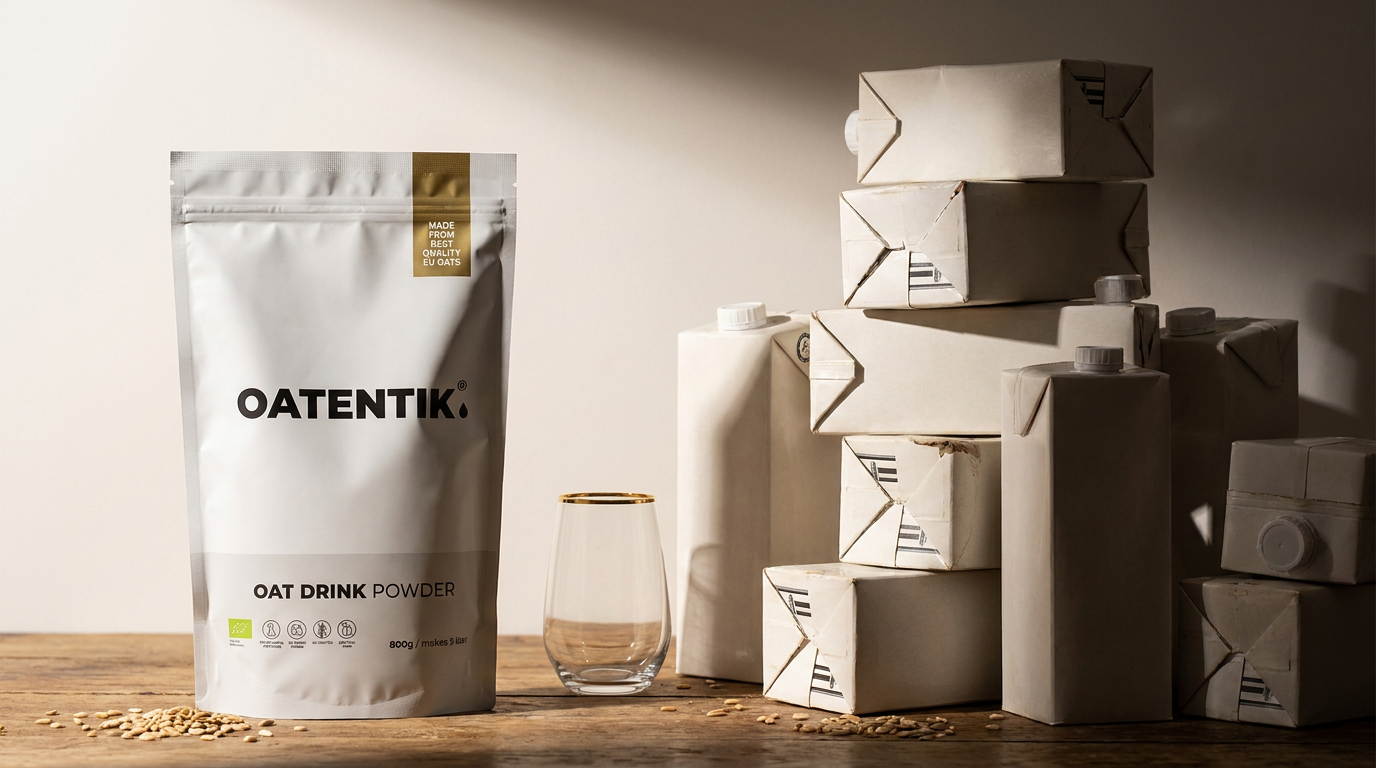
This is the approach behind OATENTIK. It uses organic gluten-free oats and a natural enzyme. Nothing else. One 800g pouch makes 8 liters of oat drink. You mix only what you need with water. As a bonus, that compact format uses 93% less packaging than the cartons it replaces
. That is 17g of pouch instead of 240g of carton for the same 8 liters.
One customer described the difference after years of making oat drink at home.
"Been making oat drink from scratch with a blender and nut milk bag for 2 years. It was fine but took 20 minutes and the mess was real. Tried the powder version and I genuinely cannot go back. Same clean ingredients, done in 30 seconds."
Frequently Asked Questions
How much protein is in oat drink?
A standard 200ml serving of oat drink usually provides 1 to 3 grams of protein. This is more than almond drink but less than soy or dairy. The exact amount depends on how much oat is in the drink and whether the solids are filtered out.Does oat drink contain fiber?
Yes. Oats naturally contain a soluble fiber called beta-glucan. The amount in the final drink depends on processing. Filtering can remove some fiber. Unfiltered or powder-based drinks may retain more.Why does unsweetened oat drink still show sugar on the label?
The sugar comes from the oat starch. During processing, enzymes break some of the starch into natural sugars. This is naturally occurring sugar, not added sugar. The ingredient list will tell you if any sugar was added on top.Is oat drink gluten-free?
Oats are naturally gluten-free. The risk is cross-contamination during processing. To be sure, look for a certified gluten-free label. OATENTIK is certified gluten-free under EU Regulation 828/2014.Why do some oat drinks contain oil?
Brands add oil, usually rapeseed or sunflower, to improve mouthfeel and texture. The oat itself contains very little fat. The added oil raises the calorie and fat count on the label. A drink made only from oats and water does not need it.OATENTIK uses only organic oats and a natural enzyme. No oils. No gums. No added sugar. Try it →
Sources & Methodology
This article cites independent research about oats and their nutrients, not about OATENTIK specifically. We have not lab-tested per-serving values for OATENTIK, including its beta-glucan content. Nutritional ranges for oat and other plant drinks are general figures and vary by brand. All research citations were verified as of April 2026. We update this article when new evidence emerges. If you notice any inaccuracies, contact us at info@oatentik.com.
Disclosure: OATENTIK is our product. We cite independent research about oats and their nutrients, not about OATENTIK specifically. See our methodology above.
Expert references:
- Nutri Health Info on oats and overall nutrition
- David Mathews on oat drink market and macros
- The Nutrition Source, Harvard T.H. Chan School of Public Health on oats, beta-glucan, and gluten
- Julia Zumpano, RD, LD, Cleveland Clinic on oat drink and fiber
Research citations: Onning et al. 1999 (PMID 10749030), Onning et al. 1998 (PMID 9745107), Wallerer et al. 2026 (PMID 41651068).