








Why is there rapeseed oil in your oat milk?

Why is there rapeseed oil in my oat milk?
You bought oat milk because it sounded simple. Oats. Water. Maybe a pinch of salt.
Then you turned the carton around. Rapeseed oil was the third ingredient.
You are not the only person asking this question. Search "oat milk rapeseed oil" and you will find thousands of people doing exactly what you just did. They read the label. They felt confused.
Here is the honest answer. Rapeseed oil is in oat milk for a functional reason. Not a nutritional one. The food science is clear. The health debate is messier than the internet suggests. And yes, there are oat drinks made without it.
Key Takeaways
- Rapeseed oil is added to oat milk for texture, mouthfeel, and to help it foam in coffee.
- Most major carton oat milks contain 1.5 to 4 percent rapeseed oil. It is rarely the villain seed-oil influencers claim, but it is also not why you bought oat milk.
- The "no oil" oat drinks do exist. They use other methods to create creaminess. Enzymatic processing is the main one.
- If you want oats and water, read the ingredients list. Anything more than oats, water, salt, and possibly an enzyme is a formulation choice, not a necessity.
- OATENTIK is a powder made from organic oats and a natural enzyme. No oils. No gums. No added sugar.
Why brands add rapeseed oil to oat milk
Oat milk is not naturally creamy. Blend oats and water on your own and you will get something thin, grainy, and slightly slimy. Not pleasant.
Brands need to solve three problems before they can sell oat milk in a carton:
- Mouthfeel. Real oat liquid feels watery on the tongue. Consumers expect plant milk to feel like dairy. Fat creates that feel.
- Coffee performance. Plain oat liquid splits in hot espresso. The proteins curdle. The drink looks broken.
- Foam. Baristas want microfoam. Oat liquid alone cannot produce stable foam.
Rapeseed oil solves all three. It coats the tongue, stabilises proteins under heat, and gives steam wands something to work with.
That is why almost every "barista" oat milk contains it. Oatly Barista Edition lists rapeseed oil as an ingredient on its packaging. Alpro's barista version uses sunflower oil for the same purpose.
A reader of food labels put it bluntly:
"Checked the ingredients and there's sunflower oil, gellan gum, and a bunch of stuff I can't pronounce. I switched to oat milk to be healthier, not to drink processed junk."
That mismatch between expectation and label is the entire reason this article exists.
What rapeseed oil actually does on a food-science level
Rapeseed oil is the European name for canola oil. The two are functionally identical. It is pressed from the seeds of the rapeseed plant, refined, and added to many processed foods.
In oat milk specifically, it does three things:
It emulsifies the drink. Without fat, the proteins and starches in oat liquid sit unevenly. Oil binds with water through emulsification, creating a uniform texture. It buffers heat. When espresso hits cold liquid, proteins denature and clump. Fat slows this reaction. The drink stays smooth. It creates foam structure. Steam stretches fat globules into a stable web. The microfoam you see on a flat white is mostly air held in place by fat.These functions are not unique to rapeseed oil. Sunflower oil, coconut oil, and even olive oil work. Rapeseed dominates because it is cheap, neutral in flavour, and made in Europe.
It is a formulation tool. Not an ingredient that exists for the drinker's benefit.
The honest health debate around rapeseed oil
This is where the conversation gets noisy. Two loud camps disagree.
Camp one says seed oils are inflammatory, oxidised, and industrially processed. They point to omega-6 ratios, hexane extraction, and high-heat refining."The production of rapeseed canola oil requires high friction and high heat, and many of those unstable omega-3s are already oxidized in the oil before they even make it into the milk." — Dr. Shireen Kassam, Consultant Haematologist and Founder of Plant Based Health Online
Camp two says the clinical trial data on canola/rapeseed oil is generally positive. A 2020 meta-analysis of controlled clinical trials looked at canola oil and cardiovascular risk factors and found measurable improvements in lipid profiles compared to other fats."The big theory behind seed oils is that it's omega-6 rich, it's imbalanced with omega-3s, it causes inflammation. The way they're produced and grown is problematic. They're usually GMO crops like canola oil. They spray lots of chemicals on them. Those chemicals get in the oil. They're manufactured in an industrial way that oxidizes them, that uses hexane to get rid of some of the compounds in it, deodorizes them, bleaches them, and then they're easily oxidized. So, would I want to eat an industrial food product? Probably not." — Dr. Mark Hyman, Physician, Author, and Advocate in the field of Functional Medicine
View on PubMed →
A 2018 systematic review and network meta-analysis comparing different oils and solid fats came to similar conclusions about blood lipid effects.
View on PubMed →
A 2021 review of foods and LDL cholesterol pulled together evidence from many randomised trials. The pattern across the literature has been more favourable to rapeseed and other vegetable oils than the wellness internet implies.
View on PubMed →
A more measured take from Stanford:
"One of the hardest things to do is find dirt on canola oil amidst all of the positive effects in almost every trial of canola oil. There is even a meta-analysis comparing directly the effect of canola oil versus olive oil on blood lipid profile. And maybe, unsurprisingly to some, but surprisingly to most, canola oil outperforms olive oil for improving blood lipids in the sense of lowering LDL cholesterol." — Andrew Huberman, Professor of Neurobiology, Ophthalmology, and Psychiatry at Stanford School of Medicine
And on context:
"Any ill effects to come from seed oils are because of who seed oils hang out with. It seems that people who consume a lot of seed oils consume them in conjunction with a lot of starches and perhaps with added sugars as well. And when you lump those together, you end up with a pro-inflammatory, often hypercaloric set of conditions." — Andrew Huberman, Professor of Neurobiology, Ophthalmology, and Psychiatry at Stanford School of Medicine
So is rapeseed oil bad for you? The clinical evidence does not support that claim. Is it the simplest, most natural thing to add to your morning coffee? Also no.
The real point is different. You bought oat milk because you wanted oats. Whether rapeseed oil is neutral, slightly helpful, or slightly harmful is not really the question. The question is: why is it in there at all when the label says "oat milk"?
How to read an oat milk label
Most carton oat drinks list ingredients in a similar order. Once you know the pattern, you can scan a label in three seconds.
Look for:
| Ingredient | What it does | Is it necessary? |
|---|---|---|
| Water | Base | Yes |
| Oats (usually 9 to 12 percent) | The actual oat content | Yes |
| Rapeseed oil / sunflower oil | Mouthfeel, heat stability, foam | No, if processing is done well |
| Dipotassium phosphate | Acidity regulator, prevents splitting | No, alternative methods exist |
| Gellan gum / locust bean gum | Stabiliser, prevents separation | No, alternative methods exist |
| Calcium carbonate, vitamins | Fortification | Optional |
| Salt | Flavour | Optional |
One frustrated drinker described the experience:
"Really disappointed. It tastes weirdly sweet, almost chemical. Checked the label and there's no added sugar listed but something is off. Doesn't taste like oats at all."
That sweetness she noticed is real. It usually comes from enzymatic processing, where amylase enzymes break oat starch into natural sugars. The process itself is not the problem. The problem is the gap between what the front of the carton suggests and what the ingredients list reveals.
How some oat drinks skip the oil
Oil is a shortcut. There are other ways to get creaminess.
The main alternative is enzymatic hydrolysis. This was the original method invented in 1994.
"In 1994, Swedish food scientist Ricard O developed oat milk using a groundbreaking method. Instead of just blending oats and water, which would result in a gritty drink, he used enzymes to break down the starch in oats, releasing natural sugars and creating a smooth, creamy liquid." — Ricard O, Swedish Food Scientist
The technical process:
"The core technology involves introducing a specific cocktail of enzymes, most importantly amylase, to a slurry of oats and water. The process, known as enzymatic liquefaction, works like this: the long complex carbohydrate chains of the oat starch are what make the mixture thick and slimy. Amylase enzymes act as microscopic scissors, snipping these long chains into smaller, simpler sugars, primarily the disaccharide maltose." — HOW?!, YouTube Channel Narrator (specializing in 'how it's made' content)
When you break starch down properly, the oat liquid develops natural body. The maltose sugars created by the enzyme produce gentle sweetness without adding sugar. The texture becomes smooth without needing oil.
This is harder to do at the scale of supermarket cartons. It requires more process control. It is also why some smaller or specialist brands can offer a clean ingredient list while many mass-market brands cannot.
What to look for if you want oat drink without rapeseed oil
A short checklist:
- Read the ingredients in order. If oil appears in the first five ingredients, it is in there for a reason and at meaningful quantity.
- Check for "oat base" wording. Some brands write "oat base (water, oats)" to make the front of the list look cleaner. The oil still comes after.
- Look for enzyme mentions. Brands using enzymatic processing often say so. They may also list "amylase" as a processing aid.
- Beware the word "barista". Barista versions almost always contain more added oil than the standard version. The oil is what makes them foam.
- Powder formats often skip oil entirely. Without the cold-chain and stability problems of liquid cartons, powder oat drinks can stick to oats and an enzyme.
Where OATENTIK fits
OATENTIK is oat drink powder. The ingredient list is short:
- Organic gluten-free oats (EU-grown, certified organic)
- Amylase (a natural enzyme that breaks oat starch into natural sugars during processing)
That is the full list. No rapeseed oil. No sunflower oil. No coconut oil. No gellan gum. No locust bean gum. No dipotassium phosphate. No added sugar.
The creaminess comes from how the oats are processed, not from added fat. The natural sweetness comes from the enzyme breaking starch into maltose. It is the same food-science principle that started the oat milk category in 1994. We have just kept the ingredient list to what is actually needed.
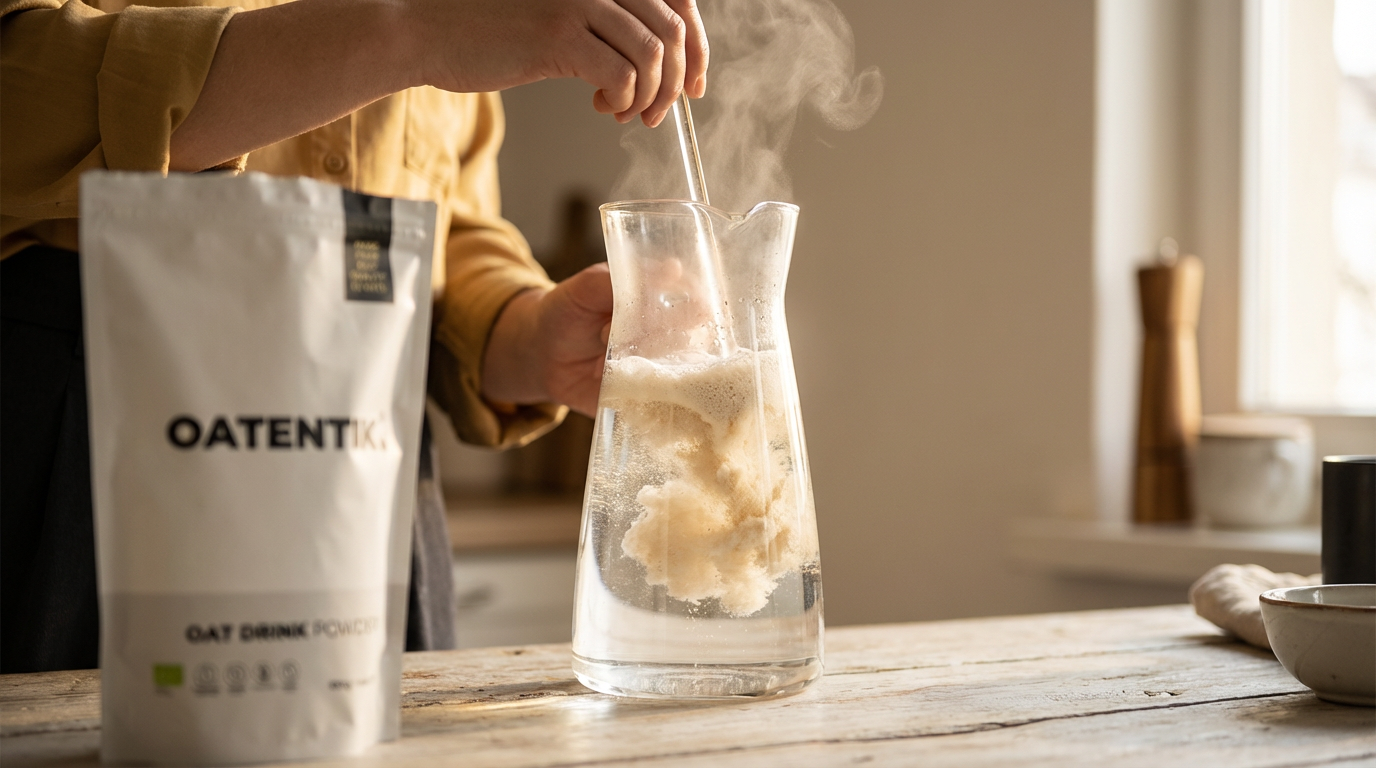
One pouch of OATENTIK powder makes 8 litres of oat drink when mixed with water. It also weighs 17 grams, which replaces roughly 240 grams of carton packaging for the same volume. That is a side benefit, not the main reason to buy it. The main reason is what is inside the pouch: oats and an enzyme.
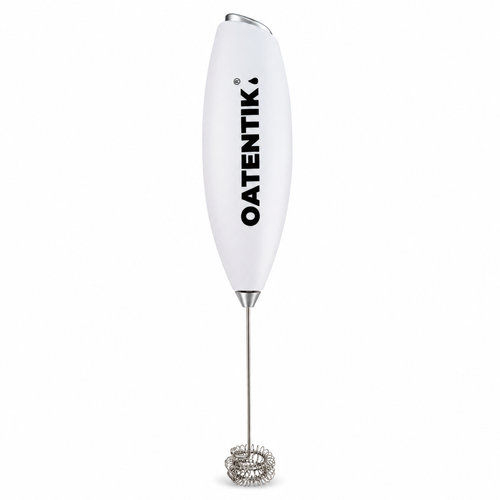
If you do want foam for coffee, a handheld frother does the job. The drink steams and froths well at higher mix ratios.
FAQ
Why is rapeseed oil in oat milk?Brands add rapeseed oil to oat milk for three reasons: it improves mouthfeel, it stops the drink from splitting in hot coffee, and it helps create stable foam when steamed. It is a formulation choice, not a nutritional one.
Is rapeseed oil in oat milk bad for you?The clinical evidence on rapeseed (canola) oil is generally favourable for cardiovascular markers like LDL cholesterol, based on multiple meta-analyses of controlled trials. The bigger issue for many drinkers is not safety, but expectation: you bought oat milk thinking it was oats and water, and it contains added oil.
Which oat milk does not contain rapeseed oil?Some smaller brands offer oat drinks without added oils. Powder formats like OATENTIK skip oil entirely because they do not need to solve liquid-carton stability problems. Always check the ingredients list. Even within one brand, the standard version and the barista version often differ.
What is the difference between rapeseed oil and canola oil?They are essentially the same oil. Rapeseed is the European name. Canola is the North American name, originally a trademarked term for a low-erucic-acid variety of rapeseed. The oil in your oat milk and the oil sold as canola in a US supermarket come from the same crop family.
Does oat milk need oil to be creamy?No. Creaminess can come from properly broken-down oat starch. When amylase enzymes split the long starch chains, the resulting liquid has natural body and gentle sweetness. Oil is a shortcut, not a requirement.
Why does barista oat milk always have more oil?Foam needs fat to hold its structure when steam stretches air bubbles into microfoam. Barista versions add more rapeseed or sunflower oil so the drink performs predictably under a steam wand. This is why barista versions usually have higher fat content than standard versions on the same brand's range.
OATENTIK uses only organic oats and a natural enzyme. No oils. No gums. No added sugar. Try the oat drink powder →
Sources & Methodology
All competitor ingredient data was sourced from official product packaging and brand websites as of April 2026. We update this article as formulations change. If you notice an inaccuracy, contact us at info@oatentik.com.
Disclosure: OATENTIK is our product. We have included it in this article because it directly addresses the question (an oat drink without rapeseed oil). We have aimed to present the science fairly, including evidence that does not support the popular "seed oils are toxic" framing.
Citations referenced:
- Oatly Barista Edition product packaging, accessed April 2026
- Alpro Oat Barista product packaging, accessed April 2026
- Schoeneck & Iggman, Nutrition, Metabolism, and Cardiovascular Diseases (2021), PMID 33762150
- Amiri, Raeisi-Dehkordi, Sarrafzadegan, Nutrition, Metabolism, and Cardiovascular Diseases (2020), PMID 33127255
- Schwingshackl, Bogensberger, Benčič, Journal of Lipid Research (2018), PMID 30006369
- Expert commentary: Dr. Mark Hyman YouTube interview (timestamp 0:58)
- Expert commentary: Andrew Huberman, Huberman Lab YouTube clips (timestamps 2:34 and 4:14)
- Expert commentary: Dr. Shireen Kassam YouTube interview (timestamp 0:59)
- Expert commentary: HOW?! YouTube channel (timestamp 5:59)
- Expert commentary: Ricard Öste YouTube reference (timestamp 5:04)

Dr. Mark Hyman Physician, Author, and Advocate in the field of Functional Medicine Watch on YouTube →"The big theory behind seed oils is that it's omega-6 rich, it's imbalanced with omega-3s, it causes inflammation. The way they're produced and grown is problematic. They're usually GMO crops like canola oil. They spray lots of chemicals on them. Those chemicals get in the oil. They're manufactured in an industrial way that oxidizes them, that uses hexane to get rid of some of the compounds in it, deodorizes them, bleaches them, and then they're easily oxidized. So, would I want to eat an industrial food product? Probably not."

Andrew Huberman Professor of Neurobiology, Ophthalmology, and Psychiatry at Stanford School of Medicine Watch on YouTube →"Any ill effects to come from seed oils are because of who seed oils hang out with. It seems that people who consume a lot of seed oils consume them in conjunction with a lot of starches and perhaps with added sugars as well. And when you lump those together, you end up with a pro-inflammatory, often hypercaloric set of conditions."
Andrew Huberman Professor of Neurobiology, Ophthalmology, and Psychiatry at Stanford School of Medicine Watch on YouTube →"One of the hardest things to do is find dirt on canola oil amidst all of the positive effects in almost every trial of canola oil. There is even a meta-analysis comparing directly the effect of canola oil versus olive oil on blood lipid profile. And maybe, unsurprisingly to some, but surprisingly to most, canola oil outperforms olive oil for improving blood lipids in the sense of lowering LDL cholesterol."
Dr. Mark Hyman Physician, Author, and Advocate in the field of Functional Medicine Watch on YouTube →"The big theory behind seed oils is that it's omega-6 rich, it's imbalanced with omega-3s, it causes inflammation. The way they're produced and grown is problematic. They're usually GMO crops like canola oil. They spray lots of chemicals on them. Those chemicals get in the oil. They're manufactured in an industrial way that oxidizes them, that uses hexane to get rid of sort of some of the compounds in it, deodorizes them, bleaches them, and then they're easily oxidized. So, would I want to eat an industrial food product? Probably not."
Andrew Huberman Professor of Neurobiology and Ophthalmology at Stanford School of Medicine Watch on YouTube →"People overvilify seed oils. One side overvilifies seed oils just like the other side overvilifies let's say your standard land animal fats like beef tallow, butter, lard. But when you compare those two, like seed oils versus the butter, beef tallow, lard, you can find more dirt as far as adverse health outcomes from the land animal fats compared to the seed oils. And that is the reality of the matter."

Natural Nan YouTube Channel Narrator (Food Science & Production) Watch on YouTube →"The process of making oat milk starts with selecting the finest oats. Typically, whole oats are used as they maintain the full nutritional profile of the grain."

HOW?! YouTube Channel Narrator (specializing in 'how it's made' content) Watch on YouTube →"The core technology involves introducing a specific cocktail of enzymes, most importantly amylase, to a slurry of oats and water. The process, known as enzymatic liquefaction, works like this: the long complex carbohydrate chains of the oat starch are what make the mixture thick and slimy. Amylase enzymes act as microscopic scissors, snipping these long chains into smaller, simpler sugars, primarily the disaccharide maltose."

Ricard O Swedish Food Scientist Watch on YouTube →"In 1994, Swedish food scientist Ricard O developed oat milk using a groundbreaking method. Instead of just blending oats and water, which would result in a gritty drink, he used enzymes to break down the starch in oats, releasing natural sugars and creating a smooth, creamy liquid."

Dr. Shireen Kassam Consultant Haematologist and Founder of Plant Based Health Online Watch on YouTube →"The production of rapeseed canola oil requires high friction and high heat, and many of those unstable omega-3s are already oxidized in the oil before they even make it into the milk."