








Oat drink powder vs carton oat milk — complete comparison

Oat Milk Powder vs Liquid: The Honest Comparison
Most people buy oat drink in cartons. That is the format the category was built on. Powdered oat drink is newer, smaller, and rarely sits on the supermarket shelf next to the cartons.
So which one is actually better?
The answer depends less on the oats and more on your kitchen, your fridge, your coffee routine and how often you finish a carton before it spoils. This guide walks through both formats fairly, with numbers where we have them and honest trade-offs where we do not.
Key Takeaways
- Liquid oat drink is pre-mixed. Powdered oat drink is mixed with water at home. Both start from oats.
- Most carton oat drinks contain added oils, gums or stabilisers. Most oat drink powders contain only oats and an enzyme.
- Powder is shelf-stable for up to 24 months. Opened cartons last 5 to 7 days in the fridge.
- Carton oat drink in EU supermarkets typically costs 1.50 to 3.00 € per liter. OATENTIK powder works out to 3.00 € per liter at single-pouch price, dropping to 2.20 € per liter on subscription.
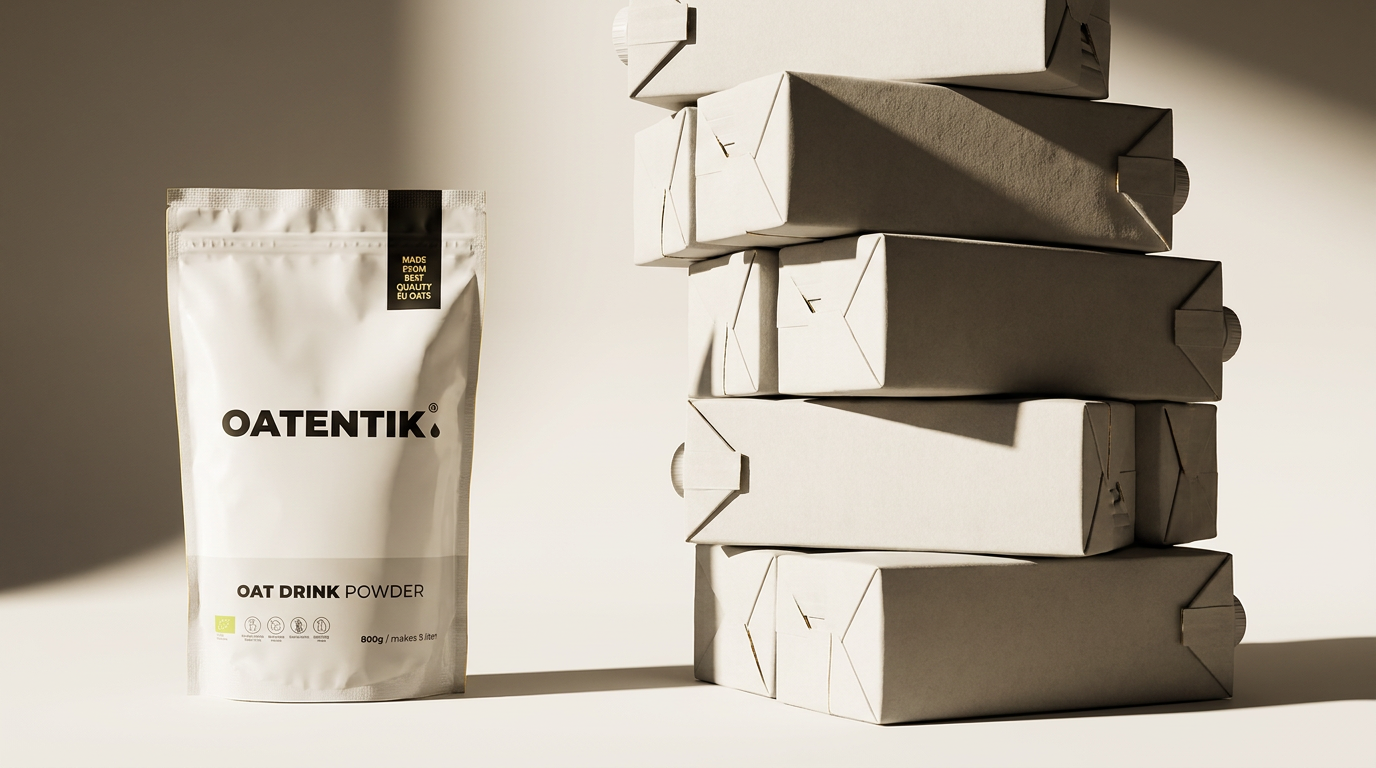
- Powder uses 17g of packaging per 8 liters. Eight cartons use roughly 240g. That is about 93% less packaging by weight
.
- Liquid wins on availability and instant pour. Powder wins on shelf life, transport, single-serve flexibility and ingredient simplicity.
Quick verdict
Choose liquid carton oat drink if you want a grab-and-pour product that is already mixed, you finish a carton within a week, and you prefer to buy from your local supermarket.
Choose powdered oat drink if you want shorter ingredient lists, longer shelf life, single-serve portions, less fridge clutter and lower transport emissions. You will need ten extra seconds to mix it with water.
Neither format is universally better. They solve different problems.
Side-by-side comparison
| Category | Liquid oat drink (carton) | Powdered oat drink |
|---|---|---|
| Format | Pre-mixed liquid, 1L carton | Dry powder, 800g pouch makes 8L |
| Typical ingredients | Water, oats, oil, salt, stabilisers, vitamins | Oats and a natural enzyme |
| Shelf life unopened | 6 to 12 months | Up to 24 months |
| Shelf life opened | 5 to 7 days, refrigerated | 3 days once mixed. Powder itself stays stable in the pouch |
| Storage | Fridge after opening | Room temperature, no fridge needed |
| Price per liter (EU retail) | 1.50 to 3.00 € | 3.00 € (single pouch) to 2.20 € (4-pack subscription) |
| Packaging per 8L | ~240g (8 cartons) | 17g (1 pouch) |
| Cold chain in transport | Often required | Not required |
| Foam in coffee | Depends on barista formulation and added oils | Depends on mix ratio and frothing |
| Availability | Most supermarkets across the EU | Online direct-to-consumer, limited retail |
| Single-serve flexibility | Low. Carton must be finished | High. Mix the exact amount you need |
| Travel friendly | No. Heavy, refrigerated, fragile | Yes. Dry, light, room temperature |
How the two formats are made
Liquid oat drink starts with oats and water. The mix is treated with enzymes that break the oat starch into smaller sugars, which is what makes oat drink naturally sweet. The base is then strained, blended with added oils, salt, stabilisers and vitamins in most cases, and finally pasteurised or UHT-treated and packed into cartons. We covered the full enzymatic process behind oat drinks in a separate article.
Powdered oat drink uses the same enzymatic step. Oats are hydrolysed with an amylase enzyme. The resulting liquid is then spray-dried into a fine powder. You add water back at home.
The simple way to think about it: liquid oat drink is powder plus water plus emulsifiers plus a long supply chain. Powder is the same oat base before water and additives are mixed in.
"A powdered alternative is lighter to transport, reducing energy, resources and emissions and the problematic packaging. It also greatly increases the shelf life, without needing refrigeration."
— Monash Innovation, _Monash University Innovation Hub_
That is the structural argument for powder in one sentence. Whether it matters to you depends on what you value.
Ingredients side by side
This is where the two formats differ most.
A typical EU supermarket oat drink carton contains:
- Water (around 90%)
- Oats (typically 8 to 12%)
- Rapeseed oil or sunflower oil
- Calcium carbonate or tri-calcium phosphate
- Salt
- Stabilisers such as gellan gum, locust bean gum or dipotassium phosphate
- Vitamins (D2, B12, riboflavin)
- Sometimes sunflower lecithin as an emulsifier
For example, Oatly Barista Edition lists rapeseed oil as its third ingredient.Ingredients: Oat base (water, oats 10%), rapeseed oil, acidity regulator (dipotassium phosphate), minerals (calcium carbonate, potassium iodide), salt, vitamins (D2, riboflavin, B12)
Alpro Oat lists rapeseed oil and stabilisers in the same position.Ingredients: Water, oats (10%), sunflower oil, tri-calcium phosphate, sea salt, stabilisers (gellan gum), vitamins (D2, riboflavin, B12, B2)
This is a recurring frustration in customer reviews:
"Why does it say oat drink on the front but then I read the label and there is rapeseed oil and sunflower lecithin in there. I thought I was buying oats."
There is a practical reason oils and gums are added. Liquid oat drink needs to stay homogeneous in the carton for months. Oats alone separate. Oil emulsifies the texture. Gums prevent settling. Without them, you would shake the carton and pour something inconsistent.
Powdered oat drink does not have this problem. The product is dry. Nothing settles in the pouch because there is no liquid. The customer adds water and drinks within three days. No emulsifier is needed.
OATENTIK is made with organic gluten-free oats and α-amylase, a natural enzyme used to convert starch into the natural sweetness of the drink. No oil. No gums. No added sugar. No salt. No fillers.
If you want to compare specific brands on ingredients alone, our guide goes deeper, and our article walks line by line through both labels.
Taste and texture
This is the section everyone wants the honest answer to. Powder sounds suspicious. People assume it will taste like instant coffee, gritty and artificial.
The honest answer: both formats can taste good and both can taste off. It depends more on the formulation than the format.
Liquid oat drink has the advantage of being consistent. The brand controls water-to-oat ratio, fat content and final taste. You open the carton and drink. There is no user error.
Powdered oat drink depends on the mix ratio. Too little powder and it tastes watery and thin. Too much powder and it can taste heavy or porridge-like. The recommended ratio for OATENTIK is 20g powder to 200ml water for a standard cup. We cover this in detail in .
Some customers report taste problems with liquid:
"It makes my coffee taste like a bowl of porridge. I like oat drink but I don't want to drink porridge coffee. I've tried warming it, not warming it, frothing it, not frothing it. Still tastes like porridge."
"Tried using it in a smoothie and it completely dominated the flavor. Everything tasted like cardboard oat. I couldn't taste the banana or berries at all."
And some report the opposite when switching to powder:
"Finally found a way to drink my coffee without dairy and without all the additives. Made my first cup with oat drink powder this morning. Mixed in 20 seconds, frothed beautifully, no weird taste. This is actually what I was looking for all along."
We have not run a controlled blind taste test yet. When we do, we will publish results in .
Price per liter
This is where the comparison gets interesting.
Carton oat drink prices vary widely by market. Basic supermarket oat drink can be as low as 1.50 € per liter. Premium and barista versions are typically 2.50 to 3.00 € per liter across EU retail.
"Costs about 3 euros per liter at my supermarket and I go through maybe 2 liters a week. That is over 300 euros a year just on oat drink. Starting to feel like a luxury."
Powder pricing depends on volume bought:
- 1 pouch (800g, makes 8L): 24 €. That is 3.00 € per liter.
- 2 pouches (16L total): 46 €. That is 2.88 € per liter.
- 4 pouches (32L total): 88 €. That is 2.75 € per liter.
- 4-pack subscription: roughly 70.40 €. That is 2.20 € per liter, the lowest single price.
So at the entry level, powder costs roughly the same as premium carton oat drink. On subscription with a 4-pack, powder undercuts most premium cartons. Powder is not the cheapest oat drink on the market. But the comparison is closer than people expect once you set carton premium pricing next to powder volume pricing.
Worth flagging: powder has no waste from spoiled cartons. If you currently throw away half a carton every other week, your effective cost per liter consumed is higher than the price on the shelf.
Shelf life and waste
This is where the format gap is largest.
A liquid oat drink carton is shelf-stable until opened. Once you open it, it must be refrigerated and used within 5 to 7 days. After that, it sours.
"It says best before 8 months from now but it's already been open a week and it smells weird. The instructions say use within 5 days once opened. That's basically useless for a single person."
"Opened it after 3 weeks in the fridge and it smelled off. Had to throw out half a carton. At these prices that really stings."
This is the single-person problem with cartons. If you only drink oat drink in your morning coffee, a one-liter carton is more than a week of use. You either drink more than you want or you waste what is left.
Powdered oat drink solves this differently. The pouch itself is shelf-stable for up to 24 months at room temperature. Once you mix a portion with water, you have three days to use it, same as carton. The difference is that you only mix what you need. One cup of coffee, one scoop, one mix.
This is also why powder is friendlier for travel:
"I travel a lot for work and I cannot bring a carton on a plane or keep it at room temp in my bag all day. Always have to find a local shop in whatever city I land in."
A pouch goes in a suitcase. A carton does not.
For more on how long carton oat drink lasts in different conditions, see our guide on oat drink shelf life.
Convenience and storage
Liquid is faster at the moment of use. You pour it. That is the whole interaction.
Powder requires one extra step. Two scoops, water, shake or stir. About six seconds with a shaker, slightly longer with a frother for hot drinks.
Where powder wins is the rest of the kitchen. One 800g pouch sits in a cupboard. The equivalent eight cartons take up a full shelf in the fridge.
"Lugging 4 cartons home from the supermarket every week because they are so heavy and take up so much fridge space. My partner thinks I am running a small dairy operation."
There is also the shared-fridge problem:
"Took a carton to the office fridge and someone kept using it. Bought another one and the same thing happened. Now I just bring individual portions but cartons don't work that way."
Powder portions individually by design. A scoop in a small container. One office coffee at a time.
Foam and coffee performance
This is where carton and powder both have real limitations.
Carton oat drinks split in hot coffee. The acid in espresso destabilises the protein in oats, especially if the carton is cold from the fridge. Brands respond by selling "barista" versions, which add more oils and stabilisers to prevent splitting.
"I pour it into my coffee and it curdles immediately. Every single time. Switched brands three times and same result. Is hot coffee just not compatible with oat drink?"
"Bought the barista edition because regular always splits in my coffee. The barista version costs nearly double and still splits about a third of the time. Exhausting."
"The barista version has more additives than the regular version to make it foam. So I either get bad foam with clean ingredients or decent foam with more junk. Can't win."
Powder behaves differently in hot coffee. Because you mix it fresh, the protein has not been sitting in an acidic-prone state for months. OATENTIK is heat stable in hot drinks at the recommended mix ratio. For foam, the standard ratio steams and froths well with a handheld frother, and a higher mix ratio gives a denser foam.
For a full breakdown, see .
Packaging footprint
Liquid carton oat drink uses about 28 to 32 grams of packaging per liter, made of paperboard, polyethylene and a thin aluminium layer.Tetra Pak carton composition approximately 75% paperboard, 20% polyethylene, 5% aluminium Eight cartons is roughly 240 grams of packaging for 8 liters of drink.
OATENTIK's pouch weighs 17 grams and contains 800g of powder, which makes 8 liters. That is about 93% less packaging by weight for the same volume
of oat drink.
The honest caveat: the OATENTIK pouch is a multi-layer laminate. Multi-layer flexible packaging is an industry-wide challenge for recycling, and the pouch is not yet fully recyclable in most EU municipal systems. We are exploring mono-material alternatives.
Beverage cartons are marketed as recyclable, and the paper fraction usually is recycled. The polyethylene and aluminium layers require specialised facilities, and EU recycling rates for cartons vary widely by country.
The cleaner argument for powder is not recycling. It is transport. Liquid oat drink is roughly 90% water. Shipping a carton across Europe means shipping mostly water. Powder ships dry. 800g of powder versus 8kg of carton oat drink is a meaningful difference per pallet.
"Plant milk is regarded as an eco-friendly option to dairy milk, but the packaging is creating an environmental disaster. The problem lies in two places - first, liquid plant milks are over 90% water by volume, increasing the packing and transportation emissions produced."
— Monash Innovation, _Monash University Innovation Hub_
This is the strongest sustainability argument for powder, and it is structural rather than marketing. You are not shipping water.
"The powder offers several advantages: Not only does it have better physical and chemical stability, it is easier to weigh, more efficient to transport and requires less storage volume than liquid milk."
— Kathrin Kramm, _PhD student at the Institute of Solids Process Engineering and Particle Technology_
A bit of context on the category
Liquid oat drink built the category. The format did not exist at scale until Oatly's barista version landed in coffee shops in the late 2010s.
"Baristas loved it because it steamed and frothed beautifully, making it perfect for lattes and cappuccinos. Customers quickly noticed the creamy texture and subtle sweetness, and oat drink began spreading like wildfire."
— TruthStorm Media, _YouTube Channel Narrator (presenting factual information)_
That was the moment cartons became default. Powder is the next iteration. Same oats, same enzyme step, different point of mixing. The water gets added at home instead of at the factory.
There is a broader reason both formats exist:
"Milk, enriched with high-quality protein, is a healthy and nutritious food that meets people's needs. However, consumers are turning their attention to plant-based milk due to several concerns, such as lactose intolerance, allergies and some diseases caused by milk; carbon emission from cattle farming; economical aspects; and low access to vitamins and minerals."
— Yonghui Yu, _Author, Food Chemistry: X_
The audience for both formats is the same audience. The format simply changes how the product fits into a kitchen.
Who should choose powdered oat drink
Powder is the better choice if:
- You live alone or in a two-person household and waste half-finished cartons.
- You travel for work or weekends and cannot rely on local supermarkets.
- You only use oat drink for coffee, not for cereal or smoothies in bulk.
- You read ingredient labels and prefer the shortest one.
- You want shelf-stable storage and a clean kitchen cupboard instead of a full fridge.
- You drink enough oat drink to commit to a subscription.
- You care about transport emissions per liter.
Who should stay with carton oat drink
Carton is the better choice if:
- You drink large amounts daily, finish a carton in two days, and never have waste.
- You buy on impulse at the supermarket and do not plan ahead.
- You strongly prefer the consistency of a pre-mixed product.
- You do not want a single extra step in your morning routine.
- You like the specific taste profile of a particular brand and have tested it for years.
Both choices are reasonable. Format is a personal fit, not a moral question.
FAQ
Does oat milk powder taste different from carton oat drink?
It can, but the gap is smaller than people expect. Carton oat drink has added oil and stabilisers that change the mouthfeel and consistency. Powdered oat drink mixed at the recommended ratio gives a creamy texture from the oat starch itself. Some customers prefer the cleaner taste of powder. Others miss the heavier mouthfeel of barista cartons. Try one cup before deciding. We compare specific taste profiles in our guide to what oat drink tastes like.
Is oat drink powder cheaper than carton oat drink?
It depends on the volume you buy and the carton brand you compare to. Premium and barista carton oat drinks typically cost 2.50 to 3.00 € per liter in EU supermarkets. OATENTIK powder costs 3.00 € per liter at single-pouch price and drops to 2.20 € per liter on a 4-pack subscription. Powder is usually cheaper than premium carton on subscription. It is usually more expensive than basic store-brand carton.
How long does oat drink powder last after mixing?
Three days in the fridge once mixed with water. The same shelf life as opened carton oat drink. The advantage of powder is that you only mix what you need, so three days is rarely a problem. The unopened pouch itself is shelf-stable for up to 24 months at room temperature.
Why do most carton oat drinks contain oil?
Liquid oat drink needs to stay homogeneous in the carton for months. Oats alone separate over time. Adding oil emulsifies the texture and helps keep the texture consistent. Stabilisers like gellan gum or locust bean gum do the same job. None of this is needed in a powder, because the product is dry until you mix it.
Does oat drink powder froth well for coffee?
It froths well when mixed at the right ratio and frothed with a handheld milk frother or steam wand. Heat stability in hot coffee is also better with powder than with most non-barista cartons, because the protein has not been sitting in a finished liquid for months. A heavier mix ratio gives denser foam.
Is powdered oat drink more sustainable than carton oat drink?
On packaging weight per liter and on transport emissions per liter, yes. One pouch replaces eight cartons by volume, which is roughly 93% less packaging material. Powder ships dry, so a pallet of powder produces far more liters of oat drink than a pallet of carton. The honest caveat is that the powder pouch is not yet fully recyclable, while the paper fraction of cartons usually is. Both formats have packaging trade-offs.
Can I use oat drink powder for cooking and baking?
Yes. Mix the powder with water at the standard ratio for most recipes. For richer results like ice cream or baked goods, use a higher ratio of powder to water. The dry format also lets you add powder directly to dry ingredients in baking, which is harder to do with carton.
Sources and methodology
All competitor ingredient data was sourced from official product packaging and brand websites in April 2026. Prices reflect EU online retail and supermarket pricing at time of writing. OATENTIK product data comes from our verified specification sheet and certificate of analysis. We update this article as packaging, pricing or regulations change. If you spot an inaccuracy, email info@oatentik.com.
Disclosure: OATENTIK is our product. We have included it in this comparison because it fits the category. We have tried to be fair about format trade-offs, including where powder loses on convenience-of-pour and supermarket availability. Sources cited:- Oatly Barista Edition official product page, accessed April 2026.
- Alpro Oat Original official product page, accessed April 2026.
- Tetra Pak official packaging composition specifications, accessed April 2026.
- Monash Innovation Hub on powdered plant milk sustainability.
- Yonghui Yu, Food Chemistry: X on plant-based milk consumer drivers.
- TU Hamburg Institute of Solids Process Engineering on plant-based milk powders.
- TruthStorm Media on the rise of oat drink in cafés.
OATENTIK uses only organic oats and a natural enzyme. No oils. No gums. No added sugar. One pouch makes eig. You can try OATENTIK here.