

Is oat milk good for you? A Healthy Milk Alternative

Is Oat Drink Actually Good for You? An Honest Look at the Evidence
Oat drink has become the default plant-based choice in Europe. Sales keep climbing. But the question most people never get a straight answer to is simple. Is it actually good for you, or is it just a trend with good marketing?
This article looks at what oat drink is, what the research says, and what to check on the label before you buy.
Key Takeaways
- Oat drink contains soluble fiber called beta-glucan. Research links oat beta-glucan to lower LDL cholesterol.
- Most carton oat drinks contain added oils, gums, and sometimes added sugar. Read the label.
- Oat drink has less protein than cow milk or soy milk. About 1 gram per 200 ml versus 7 grams.
- Naturally occurring sugar from enzymatic processing is not the same as added sugar.
- The healthiest oat drink has the shortest ingredient list. Oats, water, and not much else.
What Is Oat Drink, Exactly?
Oat drink is made by soaking oats in water, adding a natural enzyme called amylase, then filtering the liquid. The enzyme breaks oat starch into smaller sugars. This is why oat drink tastes mildly sweet without any added sugar.
Dr. Sarah Berry explains the process clearly.
"Oat milk typically that we purchase in a supermarket typically contains about 10% oats; most of the rest of it is water. What they do to those oats to stop you having a drink that's all gloopy like the wallpaper paste that we talked about earlier, what they do is they firstly heat up those oats and dissolve them in water and finally, finally grind them. They then add enzymes in to break down the starch so to break down that carbohydrate, so to break it down into those simple glucose sugar molecules." — Dr. Sarah Berry, _Professor in Nutrition at Kings College London and Chief Scientist at Zoe_
If you want a deeper walkthrough, we covered the enzymatic process behind oat drinks in a separate guide.
So far, so good. The problem is what happens after the filtering step. Many brands add oils, stabilisers, salt, and sometimes sugar to improve texture and shelf life.
Nutrition Profile: How Does Oat Drink Compare?
Here is the nutritional comparison per 200 ml serving. Values are typical for unsweetened versions.
| Nutrient | Oat drink | Cow milk (semi-skimmed) | Soy drink | Almond drink |
|---|---|---|---|---|
| Calories | 70-90 kcal | 92 kcal | 60-80 kcal | 25-40 kcal |
| Protein | 1-2 g | 7 g | 6-7 g | 0.5-1 g |
| Fat | 1.5-3 g | 3.6 g | 3-4 g | 1-2 g |
| Carbohydrates | 13-16 g | 9 g | 1-4 g | 1-3 g |
| Fiber | 0.4-2 g | 0 g | 0.5 g | 0.3 g |
| Calcium (if fortified) | ~240 mg | 240 mg | ~240 mg | ~240 mg |
Two things stand out. Oat drink has more fiber than the alternatives. It also has less protein than cow milk or soy.
A registered dietitian sums it up.
"Oat milk has more fiber in comparison to cow's milk and other alternative milks. Specifically from beta-glucan, a super dietary fiber found in oats that's been celebrated for its cholesterol-lowering properties." — Tracy Lockwood Beckerman, _Registered Dietitian_
For a side-by-side breakdown of plant options, see our oat versus almond drink comparison.
The Beta-Glucan and Cholesterol Story
The strongest health argument for oat drink comes from a fiber called beta-glucan. It is a soluble fiber found in oats. Research has linked it to lower LDL cholesterol when consumed regularly.
A randomised controlled trial from 1999 followed men with moderately high cholesterol who drank oat drink for five weeks. Both total and LDL cholesterol fell.
View on PubMed →
Dr. Michael Greger summarised a similar trial.
"One randomized trial compared oat milk to soy milk and cow milk. They found that oat milk lowered cholesterol, total cholesterol and LDL cholesterol, more than cow milk. And similar to soy, both were equally effective. Although the effect was modest, a 9% reduction in LDL cholesterol. This is probably due to the beta glucan in oats, which is a type of fiber in there, a type of soluble fiber." — Dr. Michael Greger, _Physician and Founder of NutritionFacts.org_
One detail worth knowing. Not every oat drink delivers the same amount of beta-glucan. Processing can reduce it.
"The content of beta glucan in the oat milk varies a lot. That's because the processing of the oat milk can sometimes destroy some of the beta glucan. So, it varies a lot from brand to brand. In general, the more fiber and the more soluble fiber contained, the higher the likelihood that it's a good source of beta glucan." — Dr. Michael Greger, _Physician and Founder of NutritionFacts.org_
OATENTIK contains organic oats. We have not lab-tested the specific beta-glucan content per serving.
The Protein Gap (And Why It Matters)
Oat drink is not a protein source. A 200 ml glass contains 1 to 2 grams of protein. Cow’s milk contains about 8 grams. Soy drink contains about 7 grams.
For someone using oat drink in coffee, this is irrelevant. Coffee is not a protein meal. But for a parent replacing cow’s milk in a child’s diet, or for an adult relying on plant drinks as a main source of calcium and protein, this difference matters.
Dr. Michael Greger explained the trade-off honestly:
“The main concern with oat milk is the protein content. Soy milk is pretty close to cow milk in the amount of protein, but oat milk typically has a lot less.” — Dr. Michael Greger, physician and founder of NutritionFacts.org
“If the goal is to find a substitute for cow’s milk that is nutritionally equivalent, then soy milk is a better choice. Some people prefer oat milk for the taste. They find it creamier and get their protein elsewhere. That is fine, too.” — Dr. Michael Greger, physician and founder of NutritionFacts.org
The answer is simple. If protein matters to you, you need to get it from other foods. Oat drink is a beverage, not a meal replacement.
The Sugar Question: Added or Natural?
This is where most people get confused. Oat drink usually shows 4 to 8 grams of sugar per 200 ml on the label. That looks like added sugar. In most cases, it is not.
The amylase enzyme breaks oat starch into shorter chains. Some of those chains are sugars. These are listed under "of which sugars" on the nutrition panel even though no sugar was added to the recipe.
Dr. Ben Finio explains the mechanism.
"One thing we can do is we can break down that starch into sugar before it even goes into our mouth and this can be done using enzymes, basically the same stuff that our bodies doing inside when we actually eat the oatmeal. And all this enzyme is going to do is basically just cut up the starch into its sugary building blocks." — Dr. Ben Finio, _PhD in Mechanical Engineering, Host of Flavor Lab YouTube Channel_
That said, some brands do add sugar on top. Always check the ingredient list, not just the nutrition table.
"If you're going for some oat milk, sugar content varies a ton from brand to brand depending whether that product is sweetened or not. So ideally you want to go for a brand that doesn't have added sugars. It's unsweetened." — Dr Layne Norton, _PhD in Nutritional Sciences_
For more on how oats affect blood sugar response, see our explainer on whether oats spike blood sugar.
What to Check on the Label
This is the part most articles skip. The healthiness of oat drink depends almost entirely on what is in the carton beyond oats and water.
Kait Malthaner explains why oils show up so often.
"Oats are mainly carbohydrates, so if there is no fat added to the milk then the consistency is pretty watery. And for this reason, vegetable oils including canola and sunflower oil are often added into oat milks." — Kait Malthaner, _BSc Nutrition & Exercise, Certified Health and Nutrition Coach_
Customers notice the same pattern.
"Why does it say oat milk on the front but then I read the label and there is rapeseed oil and sunflower lecithin in there. I thought I was buying oats."
And the lists keep growing.
"The ingredient list keeps changing. Last year it was simpler. Now there's dipotassium phosphate, locust bean gum. Why do they keep adding stuff?"
Here is a simple checklist for label reading.
- Oats listed first. If water comes first by a wide margin, the oat content is low.
- No added sugar. "Cane sugar", "agave syrup", "rice syrup" all count as added sugar.
- No oils if you prefer. Rapeseed and sunflower oil are common. They are not harmful, but they change what you are drinking from "oats" to "oats plus oil".
- Few or no stabilisers. Gellan gum, locust bean gum, dipotassium phosphate. These are texture aids.
- Fortification, if you want it. Calcium, vitamin D, vitamin B12. Useful if oat drink replaces dairy in your diet.
A registered dietitian gives the same advice.
"Just like with all food products, before it's on the table, read the label. Some varieties sneak in unnecessary added sugar or oils like canola oil during the manufacturing process to maintain structure and viscosity." — Tracy Lockwood Beckerman, _Registered Dietitian_
We dig deeper into the additive question in our piece on oat drink benefits and what to watch for.
Who Should Drink Oat Drink (And Who Should Not)
Good fit for:- People avoiding lactose or dairy
- People with nut or soy allergies
- People who want extra soluble fiber in their diet
- People who like the taste in coffee, tea, or porridge
- Infants under 12 months. Oat drink is not nutritionally complete for infants.
- People who need higher protein per glass. Soy or cow milk fits better.
- People with coeliac disease, unless the product is certified gluten-free. Standard oats can be cross-contaminated with wheat.
If gluten is a concern, check for certified gluten-free oats on the label. EU Regulation 828/2014 sets the standard at 20 mg/kg or less.
Powder Format: A Quick Note
Most oat drinks come in cartons. The carton format means the drink is mostly water. To keep that water mixture stable for months, brands often add oils and stabilisers.
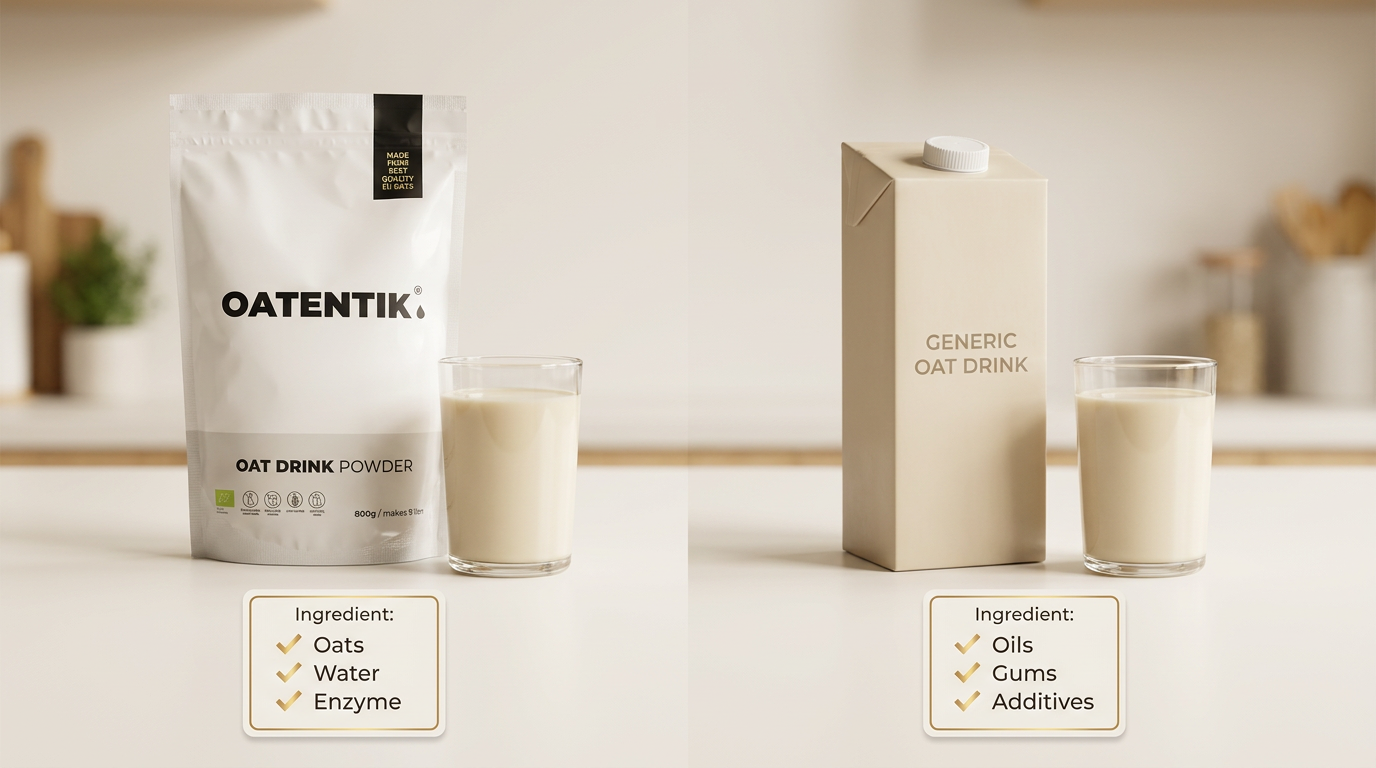
Oat drink powder works differently. You mix the powder with water yourself. Because the drink is fresh, the powder does not need oils or stabilisers to hold its texture. You get oats and a natural enzyme. Nothing else.
This format also means less packaging. A single 800g pouch makes 8 litres of oat drink. That replaces eight cartons. The pouch weighs 17g compared to roughly 240g of carton for the same volume.
For shelf life details on liquid versus powder, see our explainer on whether oat drink goes bad.
Frequently Asked Questions
Is oat drink healthier than cow milk?
It depends on what you measure. Oat drink has more soluble fiber and no cholesterol. Cow milk has more protein and more naturally occurring calcium. Neither is universally healthier. The right choice depends on your diet and your goals.
Why does oat drink contain sugar if nothing is added?
The amylase enzyme used in production breaks oat starch into smaller carbohydrates, including natural sugars. These show up on the nutrition label under "of which sugars" but are not added during the recipe. Check the ingredient list to confirm no sugar was added on top.
Does oat drink raise blood sugar?
Oat drink contains carbohydrates and some of them are simple sugars from the enzymatic process. The fiber content slows absorption compared to a pure sugar drink. For most people, a glass of unsweetened oat drink is a moderate-glycemic choice. People managing diabetes should check labels and consult their dietitian.
Is oat drink safe for people with gluten intolerance?
Only if the product is labelled gluten-free. Standard oats are often processed in facilities that also handle wheat. EU Regulation 828/2014 requires certified gluten-free products to contain 20 mg/kg or less.
Does oat drink lower cholesterol?
Research on oat beta-glucan has linked regular intake to lower LDL cholesterol. The size of the effect depends on the dose and the beta-glucan content of the specific product. Processing reduces beta-glucan in some commercial oat drinks. The 1999 RCT cited above is one example of the evidence base.
How much oat drink can I drink per day?
There is no official upper limit for healthy adults. A glass or two per day fits easily into a balanced diet. If you are using oat drink as your main dairy replacement, make sure your protein and calcium needs are covered from other foods or fortified products.
OATENTIK is organic oat drink powder. Two ingredients only. Organic gluten-free oats and a natural enzyme. No oils. No gums. No added sugar. Mix with water in seconds. See the product →
Sources & Methodology
All nutritional values for cow milk and competitor plant drinks were sourced from USDA FoodData Central and manufacturer nutrition panels at time of writing (April 2026). Research citations link to PubMed-indexed studies. Expert commentary is drawn from publicly available YouTube interviews and podcast appearances.
- Dr. Sarah Berry on oat drink production
- Tracy Lockwood Beckerman on fiber and label reading
- Dr. Michael Greger on cholesterol and protein
- Dr Layne Norton on sugar in oat drinks
- Dr. Ben Finio on enzymatic hydrolysis
- Kait Malthaner on added oils
- Onning et al., Annals of Nutrition and Metabolism (1999), PMID 10749030
If you spot an inaccuracy, contact us at info@oatentik.com.
Disclosure: OATENTIK is our product. We have included it in this comparison because it fits the category. We aim to be fair and objective in all comparisons.