

Is Oat Drink “Ultra-Processed Junk” Like Soda?

The question that won't go away
Open any nutrition forum and the same argument repeats. Someone calls oat drink "liquid candy." Someone else calls it a "clean dairy alternative." Both sides cite the same word: ultra-processed.
So which is it? Is oat drink really in the same category as soda?
The honest answer is: it depends on the oat drink. And the framework that decides this is called NOVA. Once you understand how it works, the soda comparison either holds up or falls apart, brand by brand.
Key Takeaways
- "Ultra-processed" is a technical term from the NOVA food classification system, not a general insult.
- Most carton oat drinks fall into NOVA 4 (ultra-processed) because of added oils, gums, emulsifiers, and stabilisers, not because of the oat processing itself.
- Soda is also NOVA 4, but the comparison stops there. Oat drinks deliver carbohydrates, some fibre, and naturally occurring sugars from oats. Soda delivers refined sugar and water.
- A short ingredient list (oats + water, or oats + enzyme) places an oat drink into NOVA 3 (processed), not NOVA 4.
- The processing method (heating, milling, enzymatic hydrolysis) is not the problem. The additive load is.
What "ultra-processed" actually means
The term comes from a classification system developed by researchers at the University of São Paulo. It is called NOVA. NOVA sorts foods into four groups based on the type and purpose of processing, not on calories or macronutrients.
- NOVA 1: Unprocessed or minimally processed. Fresh oats. Water. An apple.
- NOVA 2: Processed culinary ingredients. Olive oil. Sugar. Salt.
- NOVA 3: Processed foods. Made by adding NOVA 2 ingredients to NOVA 1 foods. Canned beans. Cheese. Bread with simple ingredients.
- NOVA 4: Ultra-processed. Industrial formulations with additives you would not find in a home kitchen. Emulsifiers, stabilisers, modified starches, isolated proteins, artificial flavours.
Dr. Julia Peterson summarises NOVA 4 cleanly:
"Ultra processed foods are products made in factories by combining fractionated foods with additives that make them extra tasty and able to sit on shelves for months." — Dr. Julia Peterson, Medical Doctor, PhD in Biology
The key word is additives. The NOVA scale does not condemn processing itself. Bread is processed. Yogurt is processed. Cheese is processed. None of those are NOVA 4.
A food becomes NOVA 4 when it contains substances added to mimic texture, extend shelf life, or boost mouthfeel: oils, gums, lecithins, phosphates, modified starches.
Where most oat drinks actually land
Here is where the soda comparison gets complicated. Most oat drinks on supermarket shelves do qualify as NOVA 4. But not because they are made from oats. Because of what gets added to the oats.
Look at a typical carton ingredient list:
- Oat base (water, oats)
- Rapeseed oil or sunflower oil
- Dipotassium phosphate (acidity regulator)
- Gellan gum or locust bean gum (stabiliser)
- Calcium carbonate (fortification)
- Salt
- Vitamins (added)
Each oil, gum, phosphate, and stabiliser is an ingredient you would not pour into a glass at home. That is the NOVA 4 signature.
Nutritionist Kim Pearson puts it plainly:
"Yes, most widely available oat milks are considered ultra processed. They typically contain a fairly long list of ingredients, some of which you'd probably be surprised to discover. As well as oats and water, many brands also contain thickeners, stabilisers and even oil." — Kim Pearson, Qualified and experienced nutritionist
Customers notice this even without knowing the framework:
"Why does it say oat milk on the front but then I read the label and there is rapeseed oil and sunflower lecithin in there. I thought I was buying oats."
"The ingredient list keeps changing. Last year it was simpler. Now there's dipotassium phosphate, locust bean gum. Why do they keep adding stuff?"
The instinct is correct. Each added ingredient pushes the product further into NOVA 4 territory.
Soda vs oat drink: the fair comparison
If both are NOVA 4, does that make them nutritionally equivalent? No. Same category, very different contents.
| Factor | Cola (NOVA 4) | Typical carton oat drink (NOVA 4) | Simple oat drink (NOVA 3) |
|---|---|---|---|
| Main ingredient | Water | Water + oats (often 10%) | Water + oats |
| Sugars per 200ml | ~21g added sugar | ~7g (mostly from oats, some added) | ~4g (from oats, no added) |
| Fibre per 200ml | 0g | ~0.4g | ~0.4g |
| Protein per 200ml | 0g | ~1g | ~1.3g |
| Added oils | None | Yes (rapeseed/sunflower) | None |
| Emulsifiers/gums | Some brands | Yes (gellan, lecithin) | None |
| Phosphate additives | Sometimes (phosphoric acid) | Sometimes (dipotassium phosphate) | None |
| Source of sweetness | Added sugar/HFCS | Oat-derived + sometimes added | Oat-derived only |
The categories overlap. The contents do not. A carton oat drink with oils and gums is ultra-processed. It is still not "liquid candy." It contains carbohydrates from grain, some fibre, and trace minerals. Soda contains sugar and water.
The fair takeaway: calling oat drink "the new soda" is misleading. Lumping all oat drinks together is also misleading. The brand and the ingredient list decide everything.
The processing question: is the method itself the problem?
A separate concern often gets mixed in: maybe the process of making oat drink (heating, enzymatic conversion, spray-drying or homogenisation) damages the oats and makes the final product harmful.
This is not what the research suggests. Dr. Giles Yeo, a geneticist who has studied this question, offers a useful counterweight:
"I don't see any evidence out there at the moment that the way you make the food, rather than what you add into it, actually makes it bad for you." — Dr. Giles Yeo, Geneticist, Neuroendocrinologist, and Author
In other words: the issue with NOVA 4 foods is the what, not the how. Hydrolysing oat starch with an enzyme is not chemically different from what your saliva does when you chew oats. The enzyme breaks long starch chains into shorter sugars and dextrins. The result tastes naturally sweet.
That brings up a real trade-off in the enzymatic process used to make oat drinks. The same step that creates creaminess and natural sweetness also reduces beta-glucan, the soluble fibre in oats. As Biology Insights explains:
"The biggest nutritional casualty of oat milk production is fiber, specifically a soluble fiber called beta-glucan. Beta-glucan is the compound that gives whole oats their heart-health reputation, helping lower cholesterol and moderate blood sugar. But beta-glucan also makes liquids thick and viscous, which is exactly what manufacturers don't want." — Biology Insights, Science-backed information platform
This is honest context. Any oat drink, even the cleanest one, contains less fibre than a bowl of whole oats. If you are choosing oat drink primarily for fibre, eat whole oats instead. If you are choosing it as a dairy alternative for coffee, cereal, or cooking, the comparison that matters is to other dairy alternatives. We covered this in detail in our look at whether oats spike blood sugar.
What a NOVA 3 oat drink looks like
If most cartons are NOVA 4 and soda is NOVA 4, what does a NOVA 3 oat drink contain?
Dietitian Reema Patel describes the cleaner end of the category:
"Some plant-based milks are less processed - such as organic options. These are usually a mix of the plant product and water, with nothing else added." — Reema Patel, Dietitian at Dietitian Fit
And her shopping advice for anyone trying to avoid NOVA 4:
"Choose one that contains no added sugars or sweeteners. It would also be ideal to choose one without any preservatives, thickeners or added oils. Although these give the product a longer shelf-life, they contribute to the processing of the milk." — Reema Patel, Dietitian at Dietitian Fit
That checklist is the practical way to step out of NOVA 4:
- No added oils
- No gums or emulsifiers
- No phosphate additives
- No added sugars or sweeteners
- No preservatives
What is left? Oats, water, and the natural processing required to turn one into the other. That is NOVA 3. It is not the same category as soda.
Where OATENTIK fits
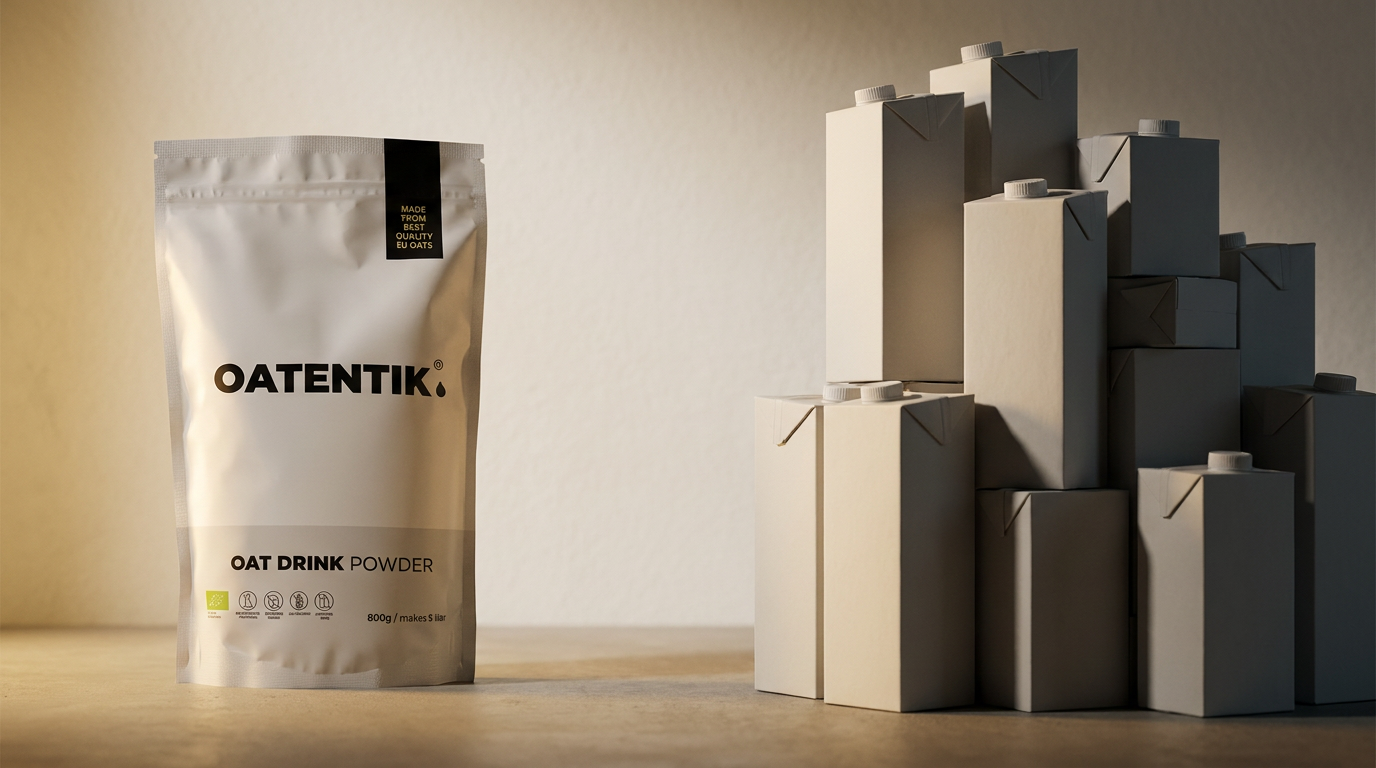
OATENTIK is an oat drink powder. The ingredient list is two items: organic gluten-free oats and α-amylase, a natural enzyme that breaks oat starch into natural sugars. No oils. No gums. No emulsifiers. No stabilisers. No added sugar. No preservatives.
When you mix it with water, you get oat drink. The sugars in the final cup (about 4.2g per 200ml serving) come entirely from the oats themselves, released by the enzyme. This is the same chemistry that happens when amylase in your saliva starts breaking down starch the moment you chew bread.
By the NOVA framework, this puts the final drink at NOVA 3, not NOVA 4. We are not making a health claim here. We are describing the ingredient list and letting the framework do its work.
For the broader question of how oat drinks compare to other plant milks on processing and additives, see our breakdown of oat milk versus almond milk.
So is oat drink "ultra-processed junk like soda"?
The short version:
- If you buy a typical carton with oils, gums, and phosphates, it qualifies as NOVA 4. So does soda. They share a category. They do not share contents.
- If you choose an oat drink with only oats, water, and (in some cases) a single enzyme, it is NOVA 3. It is processed, but not ultra-processed. Soda is not in this category at all.
- The processing method (heat, enzymes, drying) is not the issue. The additive load is.
- The headline "oat milk is the new soda" is an overgeneralisation that lumps every brand together. Read the label. Two oat drinks can sit in completely different NOVA categories.
The cleanest practical filter is the one Reema Patel suggests: no added oils, no gums, no preservatives, no added sugars. If a product passes that filter, the soda comparison does not hold.
FAQ
Is all oat drink ultra-processed? No. Most popular carton brands qualify as NOVA 4 because they contain added oils, gums, and stabilisers. Oat drinks made with only oats and water, or oats and a natural enzyme, fall into NOVA 3 (processed) rather than NOVA 4 (ultra-processed). Why is oat drink sometimes called "the new soda"? The comparison comes from the fact that both can sit in the NOVA 4 category. But the contents differ significantly. Soda is sugar and water. Carton oat drink contains oats, water, oils, and stabilisers. The categorisation is the same. The nutritional profile is not. Does the sugar in oat drink count as added sugar? It depends on the brand. Some oat drinks add sugar or sweeteners. Others, including those made with enzymatic hydrolysis, contain only naturally occurring sugars released from oat starch by enzymes. Always check the label for "added sugar" or "sweetener" in the ingredient list. Note that "sugars" on the nutrition panel includes both added and naturally occurring sugars. Is enzymatic hydrolysis a bad processing method? There is no evidence that the method itself is harmful. Amylase is the same family of enzymes your body produces in saliva and pancreatic fluid to break down starch. The process turns long starch chains into shorter sugars, which is what gives enzymatically processed oat drinks their natural sweetness without added sugar. What is the cleanest oat drink I can buy? Look for products with the shortest ingredient list. The cleanest options contain only oats and water, or oats, water, and a single enzyme. Avoid products listing rapeseed oil, sunflower oil, dipotassium phosphate, gellan gum, locust bean gum, or "natural flavours." Organic certification is a useful additional filter, though not a guarantee of a short ingredient list. Does cleaner mean more nutritious? Not necessarily. Fortified carton oat drinks often add calcium, vitamin D, and B12, which a plain oats-and-water drink does not contain. A cleaner ingredient list means fewer additives. It does not automatically mean more vitamins. If you rely on plant drink for calcium or B12, check the label or get those nutrients from other foods.OATENTIK uses only organic gluten-free oats and a natural enzyme. No oils. No gums. No emulsifiers. No added sugar. One pouch makes 8 litres of fresh oat drink, mixed in seconds. As a bonus, 17g of packaging replaces the 240g of cartons you would otherwise need for the same 8 litres. Try the organic oat drink powder →
Disclosure: OATENTIK is our product. We have included it in this comparison because it fits the category. We aim to be fair and objective in all comparisons.
Sources & Methodology
All ingredient data was sourced from official product packaging and brand websites as of 2026-05-29. Prices reflect publicly available retail prices at time of writing.
We update this article regularly. Last updated: 2026-05-29.
Found an inaccuracy? Let us know.