

How is oat milk made: A Simple Guide

How Is Oat Milk Made? The Short Answer
Oat milk is made by mixing oats with water, breaking down the starch with enzymes, and straining the liquid. That is the whole recipe at the most basic level. The drink you buy in a carton goes through a few more steps, but the core process is simple.
This guide explains each step in order. We cover the homemade version, the industrial version, and the newer powder format. By the end, you will understand why some oat drinks taste sweet without added sugar, why others contain oil, and what the enzymes actually do.
Key Takeaways
- Oat milk is made from oats, water, and an enzyme called amylase.
- The enzyme breaks oat starch into natural sugars. This creates the sweetness without any added sugar.
- Industrial oat drinks are filtered, sometimes fortified with vitamins, and packaged.
- Many carton oat drinks add oils, gums, or stabilisers to improve texture and shelf life.
- Oat drink powder skips the water-shipping step. The drink is mixed at home in seconds.
Step 1: Selecting the Oats
Every oat drink starts with whole oats. The quality of the grain affects the taste, the colour, and the nutritional profile of the final drink.
"The process of making oat milk starts with selecting the finest oats. Typically, whole oats are used as they maintain the full nutritional profile of the grain." — Natural Nan, _YouTube Channel focused on natural processes and food production_
Most commercial producers use oats grown in Europe or North America. Some use gluten-free certified oats. Standard oats are naturally gluten-free, but they are often processed in facilities that also handle wheat. A gluten-free certification means the oats were grown, harvested, and processed without cross-contamination. You can read more about this in our guide on whether oat milk is gluten free.
Step 2: Mixing Oats With Water
The oats are combined with water to form a slurry. The ratio varies by producer, but most use roughly 1 part oats to 8-10 parts water for the initial mix.
For homemade oat milk, the temperature of the water matters. Cold water is the standard recommendation.
"Please just use cold water because hot water is going to actually heat up the oats and it's going to make it like oatmeal. We do not want oatmeal." — Graham, _Recipe Developer and Blogger at The Banana Diaries_
Hot water cooks the starch and creates a gummy, slimy texture. Cold water keeps the starches stable until the enzyme step.
Step 3: Enzymatic Hydrolysis (The Key Step)
This is the step that transforms a watery oat slurry into a creamy drink. It is also the step most consumers do not know about.
Oat starch is a long chain of sugar molecules. In its natural form, starch is thick, pasty, and not particularly sweet. To turn it into something drinkable, producers add an enzyme called amylase. Amylase cuts the long starch chains into shorter chains and free sugars.
"Enzymes naturally present in oats begin to break down starches into simpler sugars, enhancing the sweetness of the final product." — Natural Nan, _YouTube Channel focused on natural processes and science_
The technical name for this step is enzymatic liquefaction. It is the same principle used in brewing beer, making soy sauce, and producing many fermented foods. The inventor of modern oat drink technology described it this way:
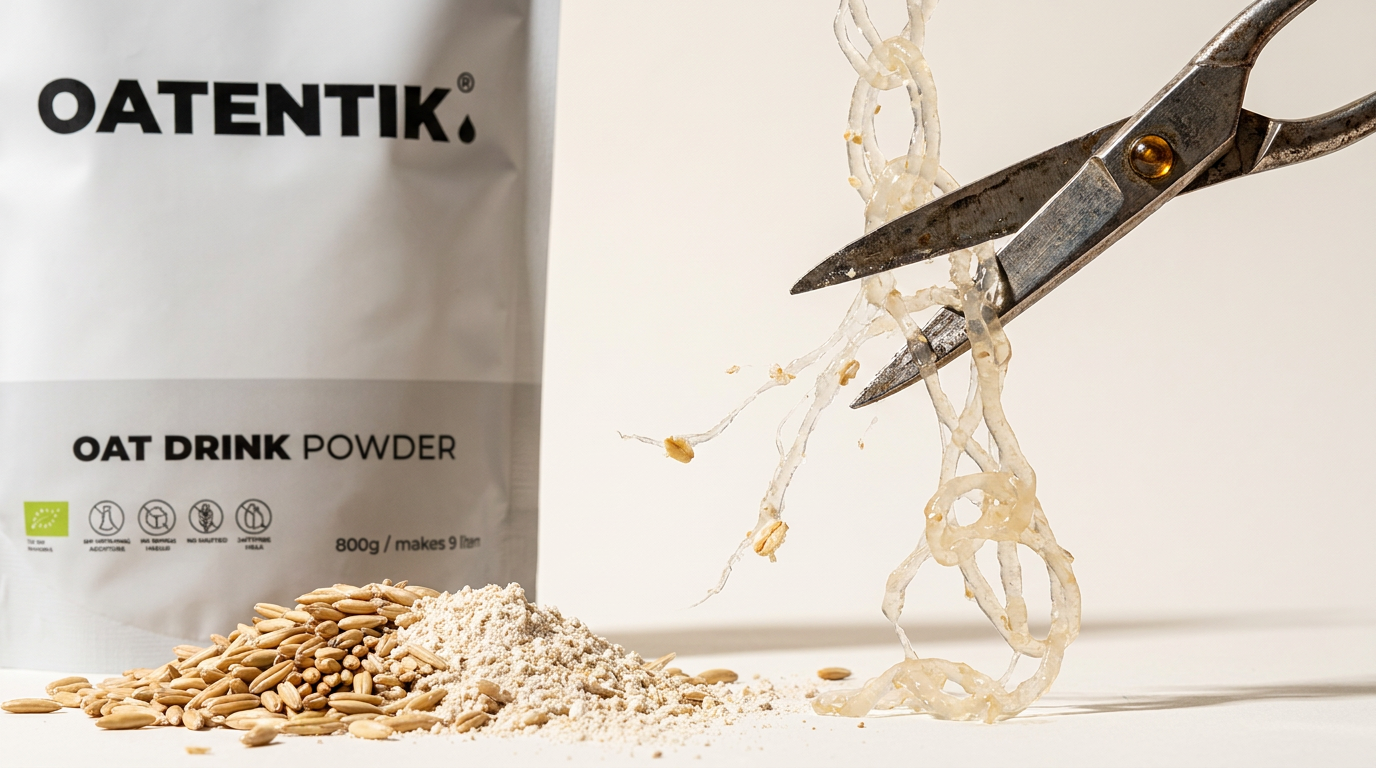
"The core technology involves introducing a specific cocktail of enzymes, most importantly amylase, to a slurry of oats and water. The process, known as enzymatic liquefaction, works like this: The long, complex carbohydrate chains of the oat starch are what make the mixture thick and slimy. Amylase enzymes act as microscopic scissors, snipping these long chains into smaller, simpler sugars, primarily the disaccharide maltose." — Ricard Öste, _Food Scientist and Founder of Oatly_
The result is a smoother, sweeter liquid. The sweetness is real sugar, but it comes from the oats themselves. No sugar is added at this stage. This is why oat drink labels can list "sugars" on the nutrition panel without listing sugar in the ingredients.
A chef explaining the process for home cooks put it more simply:
"That sliminess comes from the starches that are in the oats. To get rid of those starches, the way that most of these processing plants work, they use an enzyme, or sometimes multiple enzymes, but particularly the enzyme amylase." — Jordan Myrick, _Chef and YouTube Creator, Sauce Stache_
This step often confuses customers when they read the label. One review captures the confusion well:
"Really disappointed. It tastes weirdly sweet, almost chemical. Checked the label and there's no added sugar listed but something is off. Doesn't taste like oats at all."
The sweetness is not artificial. It is the natural maltose released by the enzyme. Some people find it pleasant. Others find it too sweet. It depends on how aggressively the producer runs the enzyme step.
Step 4: Filtering and Separation
After the enzyme has done its work, the slurry is filtered. The liquid passes through, and the solid oat fibre is separated out.
The leftover oat pulp is sometimes used as animal feed or sold as a baking ingredient. The liquid is the oat drink base.
At this stage, the drink is essentially finished. It is creamy, naturally sweet, and tastes like oats. But most commercial producers add a few more steps before packaging.
Step 5: Adding Oils, Gums, or Fortification (Optional)
Many carton oat drinks add ingredients after the enzyme step. The reasons fall into three categories.
Oils for mouthfeel. Rapeseed oil, sunflower oil, or other vegetable oils are added to make the drink taste richer and feel creamier. This is especially common in barista versions, which are designed to froth and resist splitting in coffee. Gums and stabilisers. Ingredients like gellan gum, dipotassium phosphate, and locust bean gum prevent the drink from separating in the carton. They keep the texture consistent over a long shelf life. Fortification. Vitamins and minerals are added to match the nutritional profile of dairy milk."To make oat milk a nutritional powerhouse comparable to its dairy counterpart, some manufacturers enrich the product with vitamins and minerals such as calcium, vitamin D, and vitamin B12." — Natural Nan, _Science Communicator & Educator (based on channel content)_
These additions are not inherently bad. They serve real purposes. But they surprise consumers who expect oat drink to contain just oats and water.
"Looked at the ingredients and there's sunflower oil, dipotassium phosphate, and a bunch of stuff I can't pronounce. I thought oat milk was supposed to be simple?"
This reaction is common. The base recipe is simple. The commercial product often is not.
Step 6: Heat Treatment and Packaging
The finished oat drink is heated to kill any bacteria. This is usually done with UHT (ultra-high temperature) treatment. The drink reaches around 135-150°C for a few seconds.
UHT treatment is what allows oat drink cartons to sit on a shelf at room temperature for months. Once opened, the drink behaves like fresh dairy and must be refrigerated.
The drink is then packaged into cartons, typically Tetra Pak. A standard 1-litre carton weighs around 28-32 grams empty. The packaging itself is a multi-layer laminate of paperboard, plastic, and aluminium.
How This Compares to Homemade Oat Milk
Homemade oat milk skips the enzyme step entirely. You blend rolled oats with cold water, then strain through a nut milk bag or fine cloth. The result is thinner, less sweet, and has a shorter shelf life.
| Step | Homemade | Industrial Carton | Powder Format |
|---|---|---|---|
| Oat preparation | Soaked or blended raw | Slurry with water | Slurry with water |
| Enzymatic hydrolysis | ✕ | ✓ | ✓ |
| Filtering | Manual (cloth bag) | Industrial filtration | Industrial filtration |
| Added oils or gums | ✕ | Often yes | Varies |
| Drying step | ✕ | ✕ | Yes (spray-dried) |
| Shelf life unopened | 3-5 days refrigerated | 6-12 months ambient | 12-24 months ambient |
| Final form | Liquid | Liquid in carton | Powder in pouch |
Homemade is the simplest. Industrial cartons are the most processed but the most convenient. Powder format sits in between. It uses the same enzymatic process, but the final liquid is dried into a powder so the consumer mixes the drink with water at home.
What Powder Format Changes
Oat drink powder is made the same way as carton oat drink up to a point. Oats and water, enzymatic hydrolysis, filtering. The difference comes after.
Instead of packaging the liquid into cartons, the liquid is spray-dried. Hot air evaporates the water and leaves a fine powder behind. The powder is then packaged in a sealed pouch.
When you mix the powder with water at home, you are essentially rehydrating the oat drink. The enzymatic work was already done at the factory. The drink tastes the same as the liquid version because, chemically, it is the same liquid.
The advantage is logistical. A carton is roughly 90% water by weight. Shipping cartons across Europe means shipping water. Powder ships dry. An 800g pouch makes 8 litres of drink. That is the same as eight cartons, but with 17g of packaging instead of about 240g. It is also why powder costs less per litre at scale.
Frequently Asked Questions
Why does oat milk taste sweet if there is no added sugar?
The sweetness comes from the enzymatic hydrolysis step. Amylase enzymes break the long starch chains in oats into shorter sugars, mainly maltose. These sugars are listed under "sugars" on the nutrition panel, but they are naturally derived from the oats. No sugar is added at any stage.
Is oat milk made from oat flour?
No. Oat milk is made from whole oats, not oat flour. Whole oats retain the full nutritional profile, including fibre, protein, and natural fats. The oats are mixed with water and then processed. Oat flour would behave differently in the enzyme step and would not produce the same drink.
What enzyme is used to make oat milk?
Alpha-amylase is the most common enzyme. It cuts the starch molecules into shorter chains and free sugars. Some producers use a combination of amylases and other enzymes to fine-tune the sweetness and texture. The enzyme is consumed during the process. Only trace residual activity may remain in the finished product.
Why do some oat drinks contain oil?
Oils like rapeseed or sunflower are added to improve mouthfeel and froth performance, especially in barista versions. They are not required to make oat drink. The base recipe of oats, water, and enzyme is complete on its own. Oil is a formulation choice by individual brands.
How long does homemade oat milk last?
Homemade oat milk lasts 3-5 days in the refrigerator. It does not undergo UHT treatment, so it spoils faster than commercial versions. You can read more about oat milk shelf life in our dedicated guide.
Is the enzyme used in oat milk natural?
Alpha-amylase is a naturally occurring enzyme found in many plants, fungi, and bacteria. The amylase used in food production is typically derived from microbial sources and is approved for use in EU food production. It is the same type of enzyme present in human saliva, which begins breaking down starch the moment you start chewing bread.
The Simpler Version
Most oat drink recipes follow the same basic process. Oats, water, enzyme, filter. Some brands stop there. Others add oil, gums, vitamins, and stabilisers.
OATENTIK uses only two ingredients: organic gluten-free oats and a natural amylase enzyme. The enzymatic hydrolysis happens at the factory. The liquid is then spray-dried into a powder. You mix it with water at home.
No oil. No gums. No fillers. No added sugar. The sweetness comes from the oats themselves, exactly as the process describes above.
Try the powder version of oat drink →Sources & Methodology
This article explains the standard industrial process for producing oat-based drinks. Process descriptions are based on published food science literature and direct statements by food scientists working in the category.
- Natural Nan on oat selection and the enzymatic process
- Ricard Öste on enzymatic liquefaction (founder of Oatly, inventor of modern oat drink technology)
- Jordan Myrick on amylase and starch breakdown
- Graham on cold water for homemade oat milk
If you notice any inaccuracies, contact us at info@oatentik.com.
Disclosure: OATENTIK is our product. We have included it in this comparison because it fits the category. We aim to be fair and objective in all comparisons.