

Do Oats Spike Blood Sugar? Debunking the Myths with Real Facts

Do Oats Spike Blood Sugar? The Honest Answer
Short answer: it depends on the oat, the portion, and what you eat with it.
Oats are a carbohydrate. Any carbohydrate raises blood glucose to some degree. That is normal physiology, not a problem. The real question is how high the rise is, how long it lasts, and whether your body returns to baseline within a healthy window.
This article looks at what the research actually shows. We separate the three biggest myths from the data, then give you practical rules for keeping your response steady.
Key Takeaways
- Oats raise blood sugar. So does every carbohydrate. The size and shape of the rise is what matters.
- Steel-cut and rolled oats produce a slower, smaller glucose rise than instant oats or finely milled oat flour.
- Oat beta-glucan blunts post-meal glucose rises, but only when it stays high in molecular weight.
- "Sugars" on a nutrition label can mean added sugar OR natural sugars released when starch is broken down. They are not the same thing.
- A healthy person should peak within 45 minutes and return near baseline by 90 to 120 minutes.
How Blood Sugar Works After You Eat Oats
When you eat oats, enzymes in your gut break the starch into glucose. Glucose enters the bloodstream. The pancreas releases insulin. Cells absorb the glucose. Levels return to baseline.
The shape of that curve depends on three things:
- How fast the starch breaks down (oat structure matters)
- How much fiber is present to slow absorption (beta-glucan matters)
- What else is in the meal (fat, protein, and acid all slow the rise)
Dr. Casey Means describes the pattern of a healthy response clearly:
"In a normal healthy insulin sensitive body, even if the glucose goes way up, it should come way down very quickly. It should be down by two hours, but from what I've actually seen in our most insulin sensitive people and also in research that looks at young healthy populations, you should basically be spiking and coming down about 45 minutes and come down hour and a half, 90 minutes to two hours." — Dr. Casey Means, Stanford-trained physician, Co-founder of Levels
So a glucose rise after oats is not a problem on its own. A slow return to baseline is. The form of the oat is one of the biggest levers you control.
Myth 1: "All Oats Spike Blood Sugar the Same Way"
This is the most common mistake. People look at the carbohydrate count on the label and assume every oat behaves the same. They do not.
Here is the published glycemic index range for common oat formats:
| Oat format | Typical glycemic index | Why |
|---|---|---|
| Steel-cut oats | ~52 (low-medium) | Coarse, intact bran, slow digestion |
| Rolled oats | ~55-58 (medium) | Flattened but mostly intact |
| Instant oats | ~75-79 (high) | Pre-cooked, finely cut, fast digestion |
| Oat flour | ~75+ (high) | Particle size is very small |
Myth 2: "Oat Drinks Behave Like Whole Oats"
They do not. An oat drink is made by mixing oats with water and using enzymes to break the starch into smaller, simpler sugars. The same process that makes the drink taste sweet also makes the carbohydrate faster to absorb.
This is why most carton oat drinks have a higher glycemic index than a bowl of porridge. The enzymes have already done part of the digestion before you drink it.
If you are tracking glucose response, treat oat drinks as a separate category from whole oats. We covered the enzymatic process behind oat drinks in detail elsewhere if you want the full breakdown.
Myth 3: "Sugar On The Label Means Added Sugar"
This is where many readers get confused. A nutrition label lists "of which sugars" as a sub-line under carbohydrates. That number can come from two very different sources:
- Added sugar. Cane sugar, syrups, fruit juice concentrate. This is sugar the manufacturer put in.
- Naturally released sugar. When enzymes break oat starch into shorter chains, some of those chains are simple sugars (maltose, glucose). These appear on the label as "sugars" even though no one added anything sweet.
A real customer review captures the confusion:
"Really disappointed. It tastes weirdly sweet, almost chemical. Checked the label and there's no added sugar listed but something is off. Doesn't taste like oats at all."
The sweetness in most oat drinks is genuine. It comes from enzymatic hydrolysis of oat starch, not from added sugar. The taste can be off-putting if the enzyme process is uneven or if the oat base is low quality, but the sweetness itself is real and natural.
This matters for blood sugar because added sugar and naturally released sugar from starch behave similarly in your bloodstream. Both raise glucose. The label distinction is honest, but your body still has to process the carbohydrate either way. Portion size is what matters.
Alan Aragon puts the broader point on added sugar in plain terms:
"Added sugars to the diet should be consumed judiciously. The working recommendation is to try to limit added sugars to the diet to 10% of total calories." — Alan Aragon, Nutrition Researcher and Educator
What The Research Actually Shows
The strongest evidence on oats and blood sugar focuses on beta-glucan, a soluble fiber found naturally in oats. Beta-glucan forms a viscous gel in your gut that slows the absorption of glucose.
A 2021 systematic review and meta-analysis pooled data from controlled trials measuring postprandial blood glucose after oat beta-glucan consumption.
View on PubMed →
The conclusion: oat beta-glucan reliably lowers post-meal glucose and insulin responses compared to control meals. The effect is real and reproducible.
But the dose is not the only factor. A 2023 follow-up analysis showed that the molecular weight of the beta-glucan determines whether the effect actually happens.
View on PubMed →
This is important. When oats are heavily processed, ground very fine, or treated with certain enzymes, the beta-glucan can be cut into shorter, lower-weight molecules. Shorter chains do not form the viscous gel that slows glucose absorption. So the same gram of beta-glucan, in two different products, can produce very different glucose responses.
This is part of why instant oats and oat-based snack products often have a weaker glucose-blunting effect than rolled or steel-cut oats. The processing can damage the active fiber structure, even when the fiber is still on the label.
For broader cardiovascular markers, oats also have a long evidence base.
View on PubMed →
We are not making a health claim here. We are pointing to the ingredient evidence. Oats contain beta-glucan. The fiber works best when its structure is preserved.
What Controls Your Oat Blood Sugar Response
Five practical levers determine how your body responds to oats:
1. Oat format. Steel-cut beats rolled. Rolled beats instant. Instant beats oat flour. Coarser is slower. 2. Portion size. A standard 40g porridge serving is very different from a 100g serving. Doubling the portion roughly doubles the carbohydrate load. 3. What you eat with it. Adding fat (nut butter, seeds), protein (Greek yogurt, eggs), or acid (berries) slows gastric emptying. The glucose rise becomes flatter. 4. Cooking method. Long-soaked or longer-cooked oats with more water produce a slower release than quickly microwaved oats. 5. Liquid form vs solid form. Drinking oats raises glucose faster than chewing them. The drink skips the chewing and slows down nothing.How To Eat Oats For A Steadier Response
If your goal is a smaller, slower glucose rise, the rules are simple:
- Use steel-cut or rolled oats. Avoid instant.
- Keep portions to about 40-50g dry weight per meal.
- Add fat and protein. A spoon of nut butter and a handful of seeds change the curve substantially.
- Skip the added syrups, honey, and dried fruit if you are tracking your response.
- If you drink an oat drink, drink it with a meal rather than alone.
Glucose monitors have made this kind of personal experimentation easier. As Dr. Means puts it:
"The purpose of the glucose monitor is curiosity. It's to start to understand how it's essentially an MRI for how all of our different dietary and lifestyle strategies are creating this readout of glucose in our body." — Dr. Casey Means, Stanford-trained physician, Co-founder of Levels
Two people can eat the same bowl of oats and see different curves. The general rules above hold, but individual response varies.
What About Other Concerns: Phytic Acid, Lectins, "Toxic Oats"?
Some online sources claim oats are inflammatory or "spike sugar dangerously" because of phytic acid or lectins. The evidence does not support those claims at normal dietary intake. Dr. Layne Norton addresses the phytic acid concern directly:
"Phytic acid, oh no, oh no. Phytic acid, dosage makes the poison. There's not enough phytic acid in there to do anything, and a lot of it tends to get destroyed during the cooking process." — Dr. Layne Norton, PhD in Nutritional Sciences, Physique Coach
We covered the wider oats and inflammation question in a separate article if you want the full picture.
Frequently Asked Questions
Do oats spike blood sugar more than bread?
It depends on the oat format. Whole rolled or steel-cut oats typically produce a smaller and slower glucose rise than white bread. Instant oats can be similar to white bread. The processing level is the main difference.
Why does my oat drink taste sweet if it has no added sugar?
The sweetness comes from enzymatic hydrolysis. An enzyme called amylase breaks oat starch into shorter sugar chains during production. Those shorter chains taste sweet on the tongue. No sugar is added. The "of which sugars" line on the nutrition label reflects these naturally released sugars.
Are oats safe for people with insulin resistance or type 2 diabetes?
Many people with insulin resistance tolerate steel-cut and rolled oats well, especially with added fat and protein. Instant oats and sweetened oat products tend to produce larger glucose rises. This is general information, not medical advice. Talk to your doctor or a registered dietitian if you are managing diabetes.
Does oat drink raise blood sugar more than whole oats?
Generally yes. An oat drink is partially pre-digested by enzymes, so the carbohydrate absorbs faster than chewing whole oats. Drinking it with a meal containing fat and protein slows the response.
Does the beta-glucan in oats actually help blood sugar?
Yes, when its molecular structure is preserved. Studies show oat beta-glucan reliably lowers post-meal glucose and insulin responses. The effect weakens or disappears when the beta-glucan has been broken into shorter, low-molecular-weight fragments by aggressive processing.
How much beta-glucan is in OATENTIK?
OATENTIK contains organic oats. We have not lab-tested the specific beta-glucan content per serving.
A Quick Note On OATENTIK
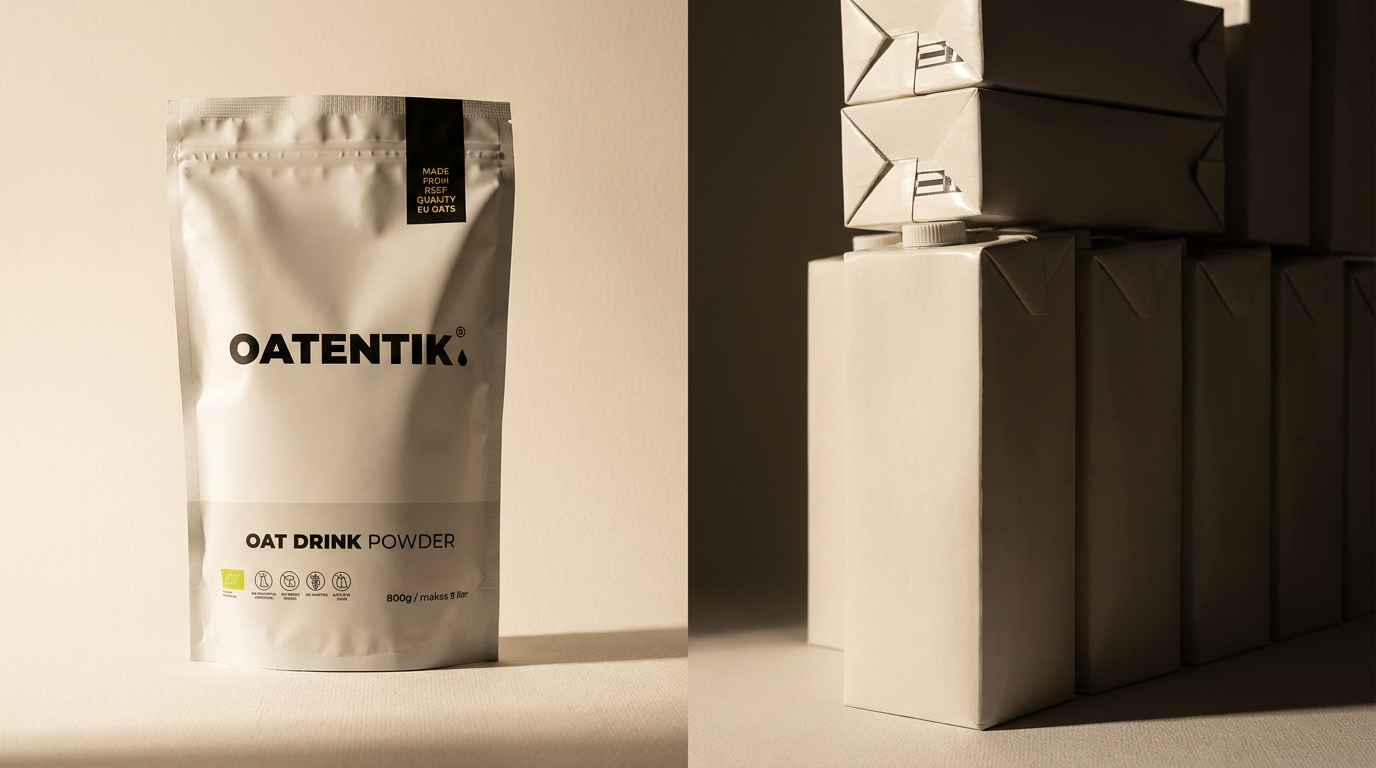
OATENTIK is an oat drink powder made from two ingredients: organic gluten-free oats and a natural enzyme (amylase). You mix it with water. There are no added sugars, no oils, no gums, no fillers.
The "of which sugars" on our nutrition panel comes from the same enzymatic process described above. The starch is broken into shorter chains during production, which is why the drink tastes naturally sweet without any sweetener added. If you are tracking your glucose response, the same rules apply: drink it with a meal, watch your portion, and pair it with fat or protein when possible.
One pouch makes 8 liters. The packaging is also about 93% lighter than the equivalent eight cartons, which is a small bonus rather than the main point.
OATENTIK uses only organic oats and a natural enzyme. No oils. No gums. No added sugar. Try the organic oat drink powder →
Sources & Methodology
This article cites peer-reviewed systematic reviews and meta-analyses indexed on PubMed. Expert commentary is drawn from public podcast and YouTube appearances by named clinicians and researchers. We update this article as new evidence becomes available. If you notice any inaccuracies, contact us at info@oatentik.com.
- Noronha JC, Zurbau A, Wolever TMS (2023). Beta-glucan molecular weight and glycaemic response. PMID 35768556.
- Zurbau A, Noronha JC, Khan TA (2021). Oat beta-glucan, postprandial glucose and insulin meta-analysis. PMID 33608654.
- Thies F, Masson LF, Boffetta P (2014). Oats and CVD risk markers systematic review. PMID 25267241.
- Expert commentary: Dr. Casey Means on glucose monitors and healthy curves
- Expert commentary: Alan Aragon on added sugar limits
- Expert commentary: Dr. Layne Norton on phytic acid and oats
Disclosure: OATENTIK is our product. We have included it in this comparison because it fits the category. We aim to be fair and objective in all comparisons.