

What is Oat Milk? Learn its Benefits & Uses

Key Takeaways
- Oat milk is a plant-based drink made by blending oats with water and filtering the liquid.
- It is naturally lactose-free, nut-free, and usually vegan.
- Most carton versions contain added oils, gums, and stabilisers. Some do not.
- Oats naturally contain beta-glucan, a soluble fiber linked to lower LDL cholesterol in clinical research.
- Oat drink works in coffee, cooking, baking, smoothies, and cereal.
- Powder formats remove the water from the supply chain and last for months in the cupboard.
What Is Oat Milk?
Oat milk is a plant-based drink made from oats and water. The oats are soaked, blended, and then filtered. The result is a creamy liquid with a mild, naturally sweet taste.
In the European Union, the product cannot legally be called "oat milk" on packaging. EU dairy regulation reserves the word "milk" for animal milk. So you will see the term "oat drink" on shelves across Germany, France, Italy, and most other EU markets. The two terms describe the same product. We use "oat drink" through most of this article for that reason.
Oat drink became popular in the late 2010s. It now sits alongside soy, almond, and coconut as one of the most common plant-based drinks in supermarkets across Europe and North America.
The basic recipe is simple. The commercial version often is not. We will get to that.
How Oat Milk Is Made
The production process has four main steps.
1. Milling. Whole oats are cleaned and milled into a coarse flour or rolled flakes. 2. Enzymatic hydrolysis. The milled oats are mixed with water. A natural enzyme called alpha-amylase is added. This enzyme breaks down the long starch chains in oats into shorter sugars. This step is what gives oat drink its natural sweetness and creamy texture. No sugar is added. The sweetness comes from the oats themselves. 3. Filtration. The mixture is filtered to remove the insoluble fiber and bran. What remains is a smooth liquid. 4. Standardisation and packaging. For carton versions, water, oils, salt, vitamins, and sometimes gums or stabilisers are added. The liquid is then heat-treated and packed into Tetra Pak cartons. For powder versions, the liquid is spray-dried into a fine powder, with no oils or stabilisers needed because the product is shelf-stable as a dry ingredient.We covered the enzymatic process behind oat drinks in more detail elsewhere if you want the full breakdown.
Oat Milk Nutrition
Nutritional values vary between brands. Carton oat drinks usually contain added water, which dilutes the oat content. Most products list 10% to 12% oats on the label.
Here is a typical nutrition profile per 200 ml serving.
Oat drink contains less protein than cow's milk. It contains more carbohydrates. It usually contains some fiber, including a soluble fiber called beta-glucan.
A registered dietitian summarised the comparison clearly:
"Oat milk generally has more protein and more fiber in comparison to cow's milk and other alternative milks. Specifically from beta-glucan, a super dietary fiber found in oats that's been celebrated for its cholesterol-lowering properties." — Tracy Lockwood Beckerman, Registered Dietitian (source)
For a deeper look at fortified versus unfortified versions, see our full oat drink nutrition guide.
Beta-Glucan and What the Research Says
The most studied component of oats is beta-glucan. This is a soluble fiber found naturally in the cell walls of oats and barley.
A clinical trial published in Annals of Nutrition & Metabolism tested oat drink consumption over five weeks in men with moderately elevated cholesterol. The researchers found a measurable reduction in serum and LDL cholesterol.
View on PubMed →
This research applies to oats and oat-based drinks as a category. The active ingredient is beta-glucan from the oats themselves.
Benefits and Practical Considerations
Oat drink suits several specific needs.
For people with lactose intolerance. Oat drink contains no lactose. It is digestible by people who cannot tolerate dairy. For people with nut allergies. Almond, cashew, and hazelnut drinks are not safe for nut-allergic households. Oat drink is. For vegan and plant-based diets. Oat drink is plant-based by default. For coffee. Oat drink steams and froths well at the right mix ratio. Many cafés use it as their default plant option.A chiropractor explained the dietary case simply:
Considerations to be aware of:"If you are lactose intolerant, then clearly oat milk is going to be the more healthy option for you. If you're vegan, then this is also going to be the better product for you and this is going to be very healthy." — Dr. Steven Hulme, Chiropractor (source)
- Oat drink contains less protein than cow's milk.
- Most cartons are fortified with calcium and B12. Unfortified versions are not nutritionally equivalent to dairy on those points.
- Some people prefer the calcium in leafy greens. As Dr. Sten Ekberg has noted: "Green stuff, vegetables, leafy greens have tons and tons of calcium and that calcium is actually much more bioavailable than it is in milk." (source)
- People with celiac disease should choose a certified gluten-free oat drink. We explain the difference in our gluten-free oat drink guide.
What's Actually In Carton Oat Milk
This is where many newcomers get a surprise. The list on the box is often longer than expected.
A common ingredient list on a barista-style oat drink includes water, oats (around 10%), rapeseed or sunflower oil, dipotassium phosphate, calcium carbonate, gellan gum, salt, and added vitamins. The oils improve mouthfeel and steaming. The phosphate buffers the pH so the drink does not split in coffee. The gum keeps the texture stable on the shelf.
This is what one customer wrote in a review:
"Looked at the ingredients and there's sunflower oil, dipotassium phosphate, and a bunch of stuff I can't pronounce. I thought oat milk was supposed to be simple?"
Not every carton is like this. Some brands sell a minimal version with just oats, water, and salt. These are usually marketed as "pure" or "simple" and tend to cost more.
Uses for Oat Drink
Oat drink works almost anywhere you would use dairy.
In coffee. Pour cold into iced coffee. Steam for cappuccinos and lattes. Choose a barista-style version for better foam, or use a higher mix ratio if you are using a powder. Our oat drink in coffee guide covers ratios and frothing technique. In tea. Add to black tea, chai, or matcha. In cereal and porridge. Pour over granola, muesli, or overnight oats. In smoothies. Blends well with frozen fruit and protein powder. In cooking. Use in soups, risottos, and pasta sauces. Replace dairy 1:1. In baking. Use in pancakes, muffins, bread, and waffles. The natural sugars give a slightly sweeter result than dairy.Oat Drink vs Other Plant Drinks
Oat drink is one of many plant-based options. Each has trade-offs.
| Drink | Protein per 200 ml | Texture | Best for |
|---|---|---|---|
| Oat | 0.6-2 g | Creamy, slightly sweet | Coffee, cereal, baking |
| Soy | 6-7 g | Smooth, neutral | Protein needs, coffee |
| Almond | 0.5-1 g | Thin, nutty | Smoothies, light use |
| Coconut | 0-0.5 g | Rich, distinct flavour | Curries, desserts |
| Rice | 0.5-1 g | Thin, sweet | Allergy-restricted diets |
Liquid vs Powder: A Format Question Most People Don't Ask
Almost all oat drink on supermarket shelves comes in a one-litre carton. That is the default. It does not have to be.
A standard carton is roughly 90% water. The oats are a small fraction of the contents. Everything else (the cold-chain transport, the carton, the shelf space, the lorries) exists to move that water from a factory to your fridge.
Powder formats skip that step. The water is removed during manufacturing. You add it back at home, one cup at a time. A few practical implications:
- Cost. Liquid oat drink in supermarkets ranges from around 1.50 to 3.50 € per litre depending on brand and country. One customer summed up the family-budget version: "I pay nearly 3 pounds for a litre. As a family of four we're spending over 40 quid a month just on oat milk. It's getting silly."
- Waste. Once a carton is opened, it lasts 4 to 7 days. If you only use 100 ml a day for coffee, the rest of the litre often spoils.
- Storage. Liquid cartons take fridge space after opening. Powder sits in the cupboard.
- Packaging. A typical carton weighs around 30 g. Eight cartons (8 litres) is roughly 240 g of packaging.
Most people drink oat drink because it is convenient. The carton format is convenient until you run out, or until you only need a splash, or until your fourth carton in two weeks goes off.
Where OATENTIK Fits
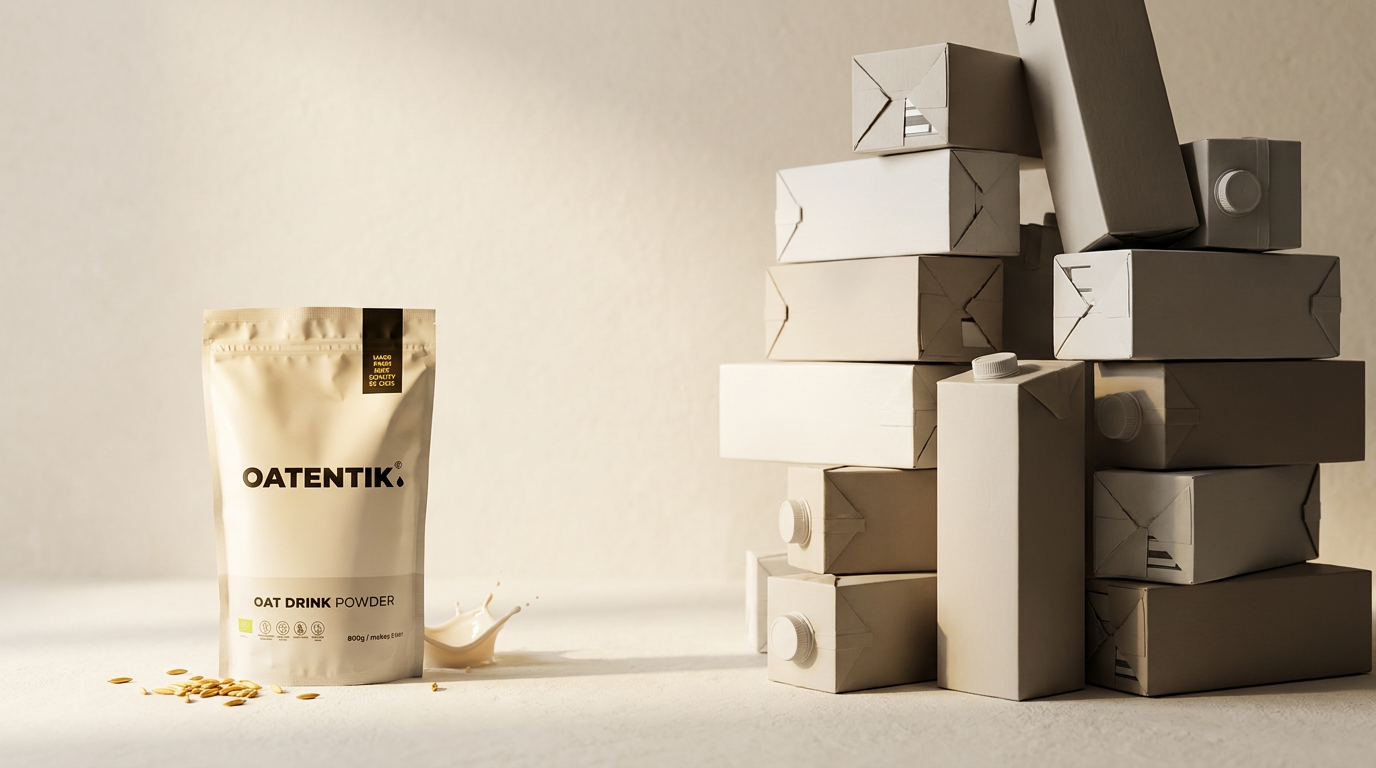
OATENTIK is an oat drink in powder form. Two ingredients: organic gluten-free oats from European farms, and a natural enzyme (alpha-amylase) that breaks down the starch into natural sweetness. No oils. No gums. No added sugar. No stabilisers. No preservatives.
You mix 20 g of powder with 200 ml of water. One 800 g pouch makes 8 litres. It stays shelf-stable for 24 months unopened. You make as much or as little as you need, when you need it.
The packaging is honest: 17 g of pouch replaces 240 g of cartons for the same 8 litres of drink. That is not a recyclability claim. Multi-layer flexible pouches are an industry-wide recycling challenge. The advantage is volume. Less material in the first place.
Pricing: 24 € for one pouch (3.00 €/L), down to 2.20 €/L on a 4-pack subscription. First order includes a free shaker and scoop.
OATENTIK uses only organic oats and a natural enzyme. No oils. No gums. No added sugar. Try it →
Frequently Asked Questions
Is oat milk healthier than dairy milk?It depends on what you mean by healthier. Oat drink contains no lactose, no cholesterol, and more fiber than dairy. Dairy contains more protein, calcium (naturally), and B12. Fortified oat drink narrows the calcium and B12 gap. The right choice depends on your specific dietary needs.
Is oat milk safe for people with celiac disease?Only if it is certified gluten-free. Oats themselves do not contain gluten, but they are often processed in facilities that handle wheat. Look for the certified gluten-free label on the packaging.
Why does my oat milk split in coffee?Hot coffee is acidic. Standard oat drink can curdle when it hits the acid. Barista-style versions add buffers like dipotassium phosphate to prevent this. Powder versions mixed at the right ratio also stay stable in hot drinks because the oat solids are concentrated.
How long does oat milk last after opening?A standard refrigerated carton lasts 4 to 7 days after opening. Use-by dates on the carton are a guide, not a guarantee. We covered this in detail in our oat drink shelf life article.
Does oat milk contain added sugar?Most plain oat drinks do not have added sugar. The sweetness comes from enzymatic hydrolysis, which breaks down the natural starch in oats into natural sugars. Always check the label. Flavoured versions (vanilla, chocolate) usually do contain added sugar.
Can you use oat milk in cooking?Yes. Oat drink works in soups, sauces, baking, and most savoury or sweet recipes. Replace dairy 1:1. The slight natural sweetness can affect savoury dishes, so taste as you go.
Is oat milk environmentally better than dairy?Studies generally show oat drink has a lower carbon footprint and uses less water than dairy. The environmental impact of cartons (transport, recycling rate) is a separate question. Powder formats remove most of the transport weight, since you are not shipping water.
Disclosure: OATENTIK is our product. We have included it in this comparison because it fits the category. We aim to be fair and objective in all comparisons.
Sources & Methodology
All ingredient data was sourced from official product packaging and brand websites as of 2026-05-06. Prices reflect publicly available retail prices at time of writing.
We update this article regularly. Last updated: 2026-05-06.
Found an inaccuracy? Let us know.